
Embark on a journey to perfect your baking and cooking with one of the most fundamental yet often daunting kitchen skills: separating egg whites from yolks. While seemingly simple, mastering this technique is crucial for achieving light, airy meringues, delicate soufflés, rich custards, and countless other culinary masterpieces. Forget single-use gadgets; this guide will reveal my tried-and-true, no-fuss method that has stood the test of a decade in the kitchen, ensuring clean and efficient separation every time. Whether you’re a seasoned baker or just starting, a firm grasp of this essential skill will elevate your culinary creations to new heights.

If you’ve been following my culinary adventures for a while, you’ve likely noticed my particular fondness for meringue-based desserts. From the ethereal lightness of angel food cake to the delicate crispness of French macarons and the elegant charm of Pavlovas, these recipes all share a common, critical starting point: perfectly separated eggs.
With a decade of intensive baking experience, I’ve had countless opportunities to refine my egg separation technique. This continuous practice has transformed what many consider a tricky task into a seamless, almost intuitive process. Over the years, I’ve encountered various methods and tools designed for egg separation. However, I’ve consistently found myself returning to the basics. My kitchen philosophy leans heavily towards practicality; I’m simply not a fan of accumulating single-use kitchen tools unless they truly revolutionize a task and are utilized with significant frequency. For egg separation, the simplest method remains the most effective and accessible.
Why Precise Egg Separation Matters for Baking and Cooking
Understanding the “why” behind accurate egg separation is just as important as knowing the “how.” Egg whites are primarily protein and water, while egg yolks are rich in fats, cholesterol, and vitamins. When whipping egg whites, the proteins trap air, creating a stable foam that gives structure and lightness to meringues, soufflés, and certain cakes. The presence of even a tiny amount of fat from the yolk can dramatically hinder this process. Fat interferes with the protein bonds, preventing the whites from aerating properly and achieving the desired volume and stiff peaks. This is why mastering separation isn’t just about technique; it’s about respecting the science of your ingredients to ensure culinary success.
How to Separate Egg Whites and Yolks: The Shell-to-Shell Method
Among the various techniques for separating egg yolks and whites, the classic shell-to-shell method stands out for its simplicity, effectiveness, and minimal need for special equipment. It relies on the natural barrier of the eggshell to cradle the yolk while allowing the white to drip away. This method, when executed correctly, is incredibly efficient and perfect for both small and large batches of eggs.
Here’s a detailed, step-by-step guide to mastering this technique:
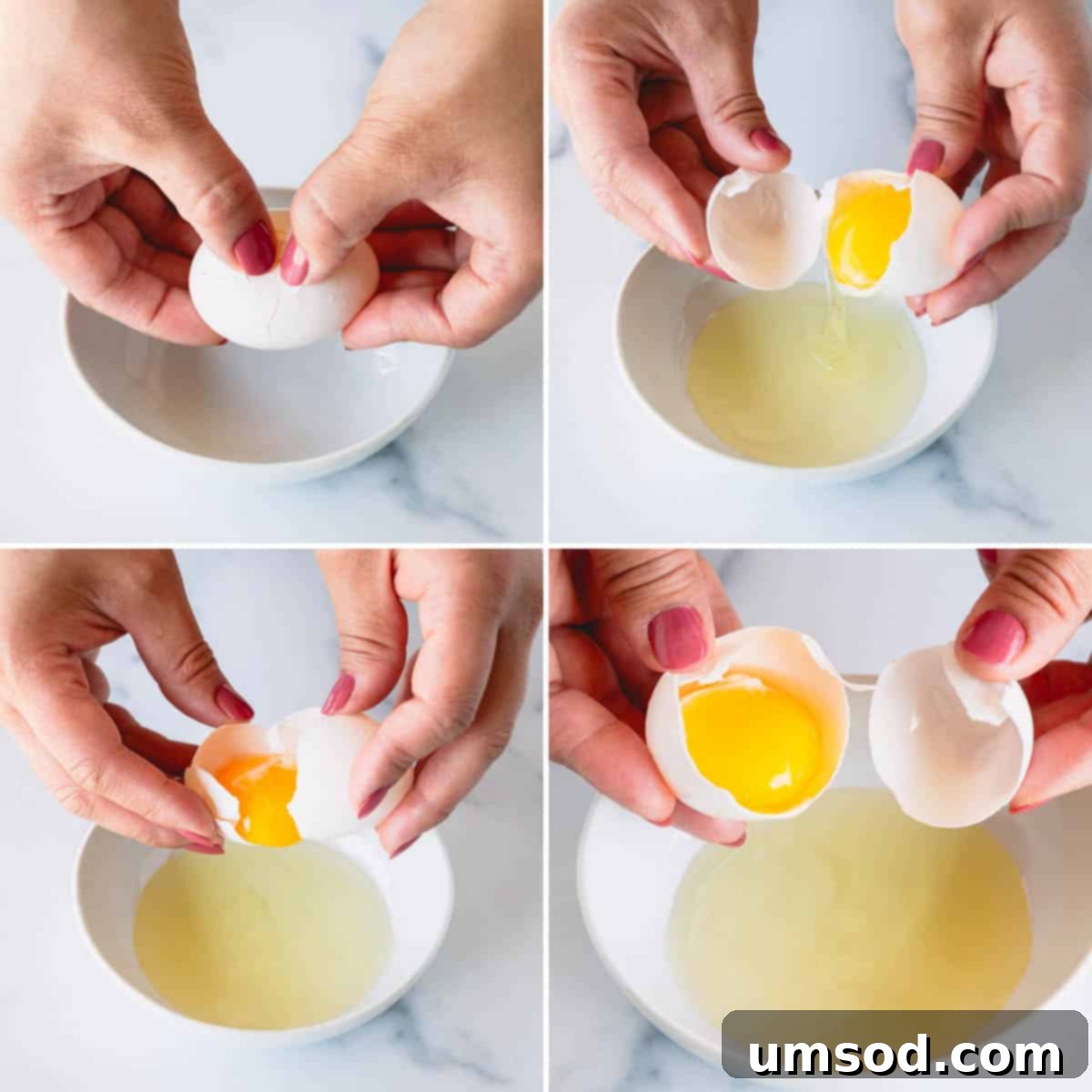
- Prepare Your Workspace with Three Bowls: This is a crucial precautionary step, especially when separating multiple eggs. Set up one small, empty bowl for the initial separation process, a larger bowl dedicated solely to collecting the egg whites, and a third bowl for the egg yolks. This three-bowl system acts as a safety net: if a yolk accidentally breaks during separation, it will only contaminate the small separation bowl, not your entire batch of already separated egg whites. This saves time and ingredients in the long run.
- Crack the Egg with Precision: Begin by cracking the egg on a flat, even surface, such as your kitchen counter. Avoid cracking it on the edge of a bowl or counter, as this can push tiny shell fragments into the egg contents, making them difficult to remove later. A gentle but firm tap should create a clean break without shattering the shell. Maintaining a steady hand is crucial to prevent any shell fragments from contaminating the egg contents.
- Hold the Egg Over the Small Separation Bowl: Carefully hold the cracked egg halves apart, positioning them directly over your designated small separation bowl. Gently open the shells, allowing roughly half of the egg white to flow out and drip into the bowl below. The goal here is to keep the yolk cradled securely in one of the shell halves. The initial drip allows some of the thinner white to escape, making the next step easier.
- Gently Transfer the Yolk (Shell-to-Shell): With the yolk still nestled in one shell half, slowly and gently transfer it to the other shell half. As you do this, more of the egg white will stream down into the bowl. Repeat this back-and-forth transfer process a few times. Each transfer allows more of the viscous egg white to separate from the yolk. Continue until you have successfully isolated the intact yolk in one shell half and the majority of the egg white has dripped into the bowl. Finally, carefully place the clean yolk into its designated yolk bowl and pour the separated white from the small separation bowl into the larger whites collection bowl.
Does a Drop of Egg Yolk Truly Ruin a Meringue? Understanding the Fat Factor
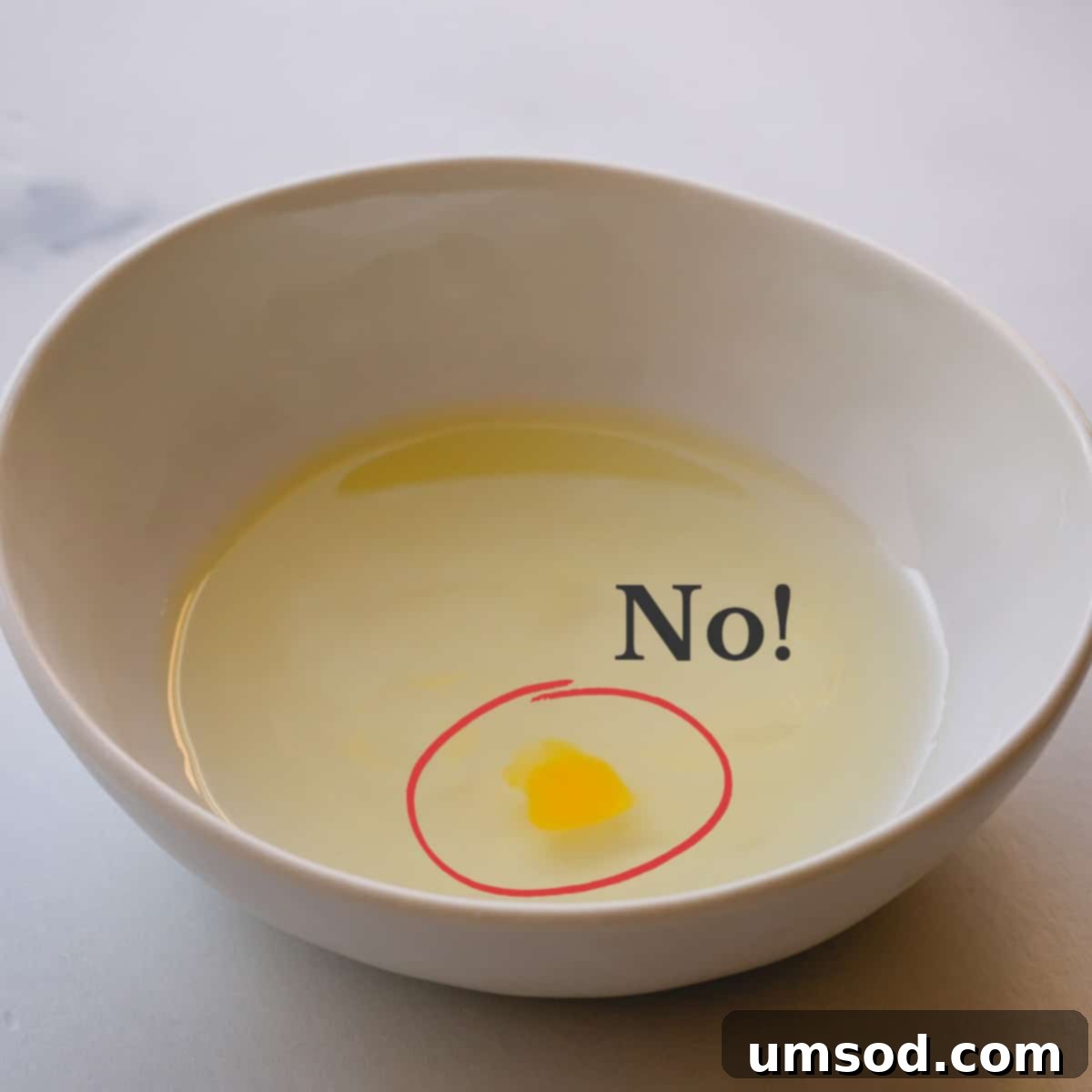
This is a question every baker has pondered. The short answer is: yes, a drop of egg yolk can indeed ruin a meringue, but the impact is often dependent on the ratio and the specific recipe. The fundamental reason lies in the composition of egg yolks: they are rich in fat. When fat comes into contact with egg whites, it acts as a disruptive agent, preventing the protein molecules in the whites from denaturing and forming the strong, stable network required to trap air and create stiff peaks.
While I consistently advise against contaminating egg whites with even the smallest amount of egg yolk when whipping for meringue, it’s truly all about the ratio. For instance, if you are preparing a delicate macaron recipe that calls for just two egg whites, a single drop of yolk can be catastrophic. The small volume of whites cannot overcome the fat’s interference, leading to flat, weeping meringues that won’t hold their shape.
However, if you’re making a voluminous Angel Food Cake that utilizes a dozen or more egg whites, a tiny, minuscule speck of yolk might not affect the overall outcome significantly. The sheer volume of uncontaminated whites can sometimes dilute the effect of a tiny amount of fat, allowing the meringue to still achieve respectable peaks. Nevertheless, even in these scenarios, it’s always best practice to aim for pristine separation.
I must admit, there have been times when I’ve carefully scooped out a tiny, barely-there drop of yolk from egg whites and still managed to produce a successful meringue. But these instances are exceptions, not the rule. To ensure consistent, high-quality results in your baking, especially with delicate desserts, always err on the side of caution. If a significant amount of yolk breaks into your whites, it’s often better to discard that batch of whites or save them for a different, non-meringue recipe, and start fresh with a new egg for separation. Your meringue will thank you!
Expert Tips for Flawless Egg Separation and Baking Success
Achieving perfect egg separation consistently comes down to a few key practices. Incorporating these tips into your routine will not only make the process easier but also significantly improve the outcome of your recipes.
- Separate Cold Eggs: This is a golden rule for easier separation. When eggs are cold, the yolks are firmer and more resilient, making them far less prone to breaking during the cracking and transferring process. The chalazae (the white stringy bits that anchor the yolk) are also tighter in colder eggs, further aiding in separation. After separation, if your recipe calls for room-temperature egg whites (which many meringue-based recipes do for optimal volume), simply let the separated whites sit on the counter for 20-30 minutes to warm up before whipping.
- Always Use Three Bowls: As detailed in the separation steps, this is your ultimate safeguard. Having one small bowl for the active separation, one for collecting all the pristine whites, and one for the yolks prevents cross-contamination. Should a yolk break accidentally in the separation bowl, only that single egg white is compromised, not your entire collection of whites. This saves time, frustration, and precious ingredients.
- Crack Eggs on a Flat Surface: Avoid cracking eggs on the sharp edge of a counter or bowl. A flat surface minimizes the chance of tiny shell fragments getting pushed into the egg. When cracking on an edge, the impact can drive microscopic pieces of shell inwards, which are incredibly difficult to spot and remove from the egg whites later. A clean, firm crack on a flat surface provides a much cleaner break.
- Use Impeccably Clean Bowls and Utensils for Egg Whites: This tip cannot be overstressed. Egg whites are highly sensitive to fat. Even a microscopic film of grease or oil on your mixing bowl or whisk can prevent the whites from whipping up properly. Glass or stainless steel bowls are the best choices for whipping and storing egg whites because they are non-porous and can be cleaned thoroughly. I strongly recommend staying away from plastic containers for any task involving egg whites. Plastic is porous and can retain residual grease within its microscopic cuts and scratches, even after washing, which can then leach into your egg whites. To be absolutely certain, some bakers wipe their bowls and whisks with a little lemon juice or vinegar before adding egg whites to ensure a completely fat-free surface.
- Wash Your Hands Thoroughly: Before and after handling eggs, ensure your hands are clean. This prevents the transfer of any oils from your skin or other food particles to the egg whites, further minimizing the risk of contamination.
- Utilize Fresher Eggs for Easier Separation: While not strictly necessary, very fresh eggs tend to have firmer yolks and stronger chalazae, making the separation process marginally easier. Older eggs might have weaker yolks that are more prone to breaking.
Smart Storing Tips for Separated Egg Whites and Yolks
After carefully separating your eggs, don’t let the unused portions go to waste! Both egg whites and yolks can be stored for future use, opening up a world of culinary possibilities.
- Storing Raw Egg Whites:
- Refrigeration: Place raw egg whites in a clean, airtight container (glass or stainless steel is ideal) and refrigerate them for up to 3 days. They are perfect for making omelets, frittatas, adding to smoothies for a protein boost, or for another batch of meringues.
- Freezing: For longer storage, raw egg whites freeze beautifully! Pour them into an airtight freezer-safe container or individual ice cube trays (then transfer frozen cubes to a bag) and freeze for up to 3 months. Thaw them overnight in the refrigerator before using. Note that frozen and thawed whites might not whip to quite the same volume as fresh whites, but they are still excellent for most cooked applications.
- Storing Raw Egg Yolks:
- Refrigeration: Raw egg yolks can also be stored in an airtight container in the refrigerator, but for a shorter period – typically up to 2 days. To prevent them from drying out or forming a skin, you can cover them with a tiny bit of water or milk before sealing the container. Discard the liquid before use.
- Freezing: Freezing raw egg yolks requires a bit more preparation. Plain egg yolks, when frozen and thawed, can become very gelatinous. To prevent this, whisk the yolks lightly with a pinch of salt (about 1/8 teaspoon per 4 yolks) for savory uses, or a pinch of sugar (about 1/2 teaspoon per 4 yolks) for sweet applications. This prevents gelling. Store them in airtight freezer-safe containers for up to 3 months.
- Creative Uses for Leftovers:
- Extra Whites: Think angel food cakes, macaroons, pavlovas, lemon meringue pie, royal icing, protein shakes, or even thickening sauces.
- Extra Yolks: Ideal for homemade pasta dough, custards (like crème brûlée or pastry cream), hollandaise sauce, mayonnaise, enriching scrambled eggs, or baking brioche.
FAQs: All Your Egg Separation Questions Answered
Yes, it is significantly easier to separate cold eggs. The yolks are firmer and less likely to break, making the process cleaner and more efficient. However, for optimal volume when whipping egg whites (especially for meringues), room-temperature whites are generally preferred. Room temperature whites have lower surface tension, allowing them to incorporate more air and achieve greater volume and stability. The best practice is to separate your eggs while they are cold, then let the separated whites sit on the counter for 20-30 minutes to come to room temperature before you begin whipping.
The “slotted spoon egg hack” involves cracking an egg over a slotted spoon, allowing the thinner egg white to drip through the holes while the yolk remains in the spoon. While it might seem convenient, its effectiveness can be quite limited, especially if you’re working with many eggs. Egg whites are not always as liquid as water; their viscosity can vary, meaning they may not drip through the holes as easily or quickly as desired. This method can become quite time-consuming and sometimes leaves a good portion of the white clinging to the yolk, requiring further effort to separate fully.
Another manual method involves cracking an egg into your clean hand and allowing the egg whites to drip between your fingers, leaving the yolk cradled in your palm. While this technique can be effective, I personally do not prefer this process. It can be quite messy, and there’s a higher risk of introducing oils from your skin to the egg whites, which, as we know, can be detrimental to meringues. Additionally, for hygienic reasons, I prefer methods that minimize direct handling of the egg contents.
Yes, absolutely! There is nothing harmful or unsafe about a blood spot in an egg. Blood spots (or meat spots, which are tissue fragments) are simply the result of a small blood vessel rupturing on the surface of the yolk during formation. As someone who regularly uses farm-fresh eggs, I encounter eggs with blood spots quite often. If you find one and prefer not to consume it, simply remove it with the tip of a paring knife or a spoon. The egg is perfectly safe to use otherwise.
Egg separator tools are widely available and certainly offer a convenient way to separate eggs. They typically feature a cup-like design with slots or holes that allow the white to drain while holding the yolk. Pros include ease of use, especially for beginners, and reducing direct contact with the egg. However, their main con is that they are often a single-use kitchen gadget, taking up drawer space. Also, depending on the design, some tools can still make it challenging for thicker whites to drain completely, or the yolk might sometimes slip through if the slots are too wide.
Thorough cleaning is paramount. Wash your bowls and whisks with hot, soapy water, ensuring all grease and food residue are completely removed. For an extra layer of assurance, especially if you’re using older bowls, you can wipe the interior of the bowl and your whisk with a paper towel dampened with white vinegar or lemon juice. The acidity helps to break down any lingering fatty residue. Rinse thoroughly and dry completely before adding egg whites. Any moisture can also negatively impact whipping.
Mastering egg separation is a foundational skill that empowers you in the kitchen, opening doors to a world of sophisticated and delightful recipes. By understanding the simple science behind it and practicing the shell-to-shell method with diligence, you’ll soon find yourself separating eggs with confidence and precision. Remember these tips: start cold, use three bowls, and prioritize cleanliness. With these techniques in your arsenal, you’re well on your way to creating stunning meringues, light-as-air cakes, and perfectly balanced dishes every time. Happy baking!
I’m sharing my tried-and-true method of separating egg whites and yolks without an egg separator. Plus, there are many tips for best practices to keep the process clean and efficient.
You may have noticed my obsession with meringue-based desserts if you’ve been around for a little bit. Angel food cake, macarons, Pavlovas, you name it!
As you can imagine, with a decade of baking, I’ve become proficient at separating egg yolk from the white.
Many methods and tools exist for separating egg yolks and whites, but I stick to the basics. I’m not a fan of single-use kitchen tools unless they’re helpful, and I use them often enough.
How to Separate Egg Whites and Yolks
One of the most efficient ways to separate egg yolks and whites is by using the shell-to-shell technique. This method involves cracking the egg in half and gently transferring the yolk between the shells.
Here’s a step-by-step guide:
- Prepare three bowls: One small bowl and two bowls for collecting egg whites and yolks.
- Crack the egg: Begin by cracking the egg on a flat surface. Maintaining a steady hand is crucial to prevent any shell fragments from contaminating the egg contents.
- Hold the egg over the small bowl: Position the cracked egg over a bowl, allowing the egg white to flow out while cradling the yolk in one of the shell halves.
- Transfer the yolk: Gently transfer the yolk between the shell halves, allowing the egg white to drip into the bowl below. Repeat this process a few times until you have successfully separated the yolk from the whites.
Does a drop of egg yolk truly ruin a meringue?
Egg yolks contain fat, and fat in the whites can hinder the whipping process, preventing the meringue from reaching the desired stiff peaks.
While I always advise not to contaminate the egg whites with even smallest amount of egg yolk, it’s all about the ratio!! When you’re making a macaron recipe with just 2 egg whites, you don’t want to contaminate it with a drop of egg yolk.
But if you’re making an Angel food cake with a dozen egg whites, a small drop of egg yolk may not affect it at all.
I’ll admit, I’ve scooped up a small drop of yolk from egg whites and still made a good meringue. But I’d err on the side of caution anyways.
Tips for Success:
- Separate cold eggs because cold egg yolks are firmer and less prone to breaking.
- Use three bowls when separating multiple eggs. Have one bowl for collecting all the egg whites, another for yolks, and a third for the separation process. This precautionary measure ensures that if a yolk accidentally breaks during separation, it won’t contaminate all the egg whites in the bowl.
- Crack the egg on a flat surface instead of the edge of a counter to reduce the chances of tiny shell fragments getting in the egg.
- Use clean bowls for egg whites. Glass or stainless steel bowls are the best for storing egg whites. I recommend staying away from plastic containers for storing egg whites because residual grease can adhere inside the cuts and scratches of the plastic.
Storing Tips:
Refrigerate raw egg whites in an airtight container for up to 3 days. You can also freeze raw egg whites for up to 3 months.
Store raw egg yolks in an airtight container in the refrigerator for up to 2 days.
FAQs:
Yes, it is. Egg yolks are firmer and less likely to break when they’re cold.
Some people use a slotted spoon to separate egg whites from yolks. While it may be helpful to crack an egg over a slotted spoon to allow the egg whites to drip through the holes, it might become quite time-consuming if you’re working with many eggs. Egg whites are not always liquid as water and may not drip through the holes as easily.
Another way to separate egg white from its yolk is to crack an egg into your hand and let the egg whites drip between your fingers.
I do not like this process, as it’s too messy.
Yes, there is nothing harmful about a blood spot in the egg. As someone who uses farm eggs all the time, I’ve run into eggs with a blood spot all the time. Simply remove it with a paring knife, if desired.