
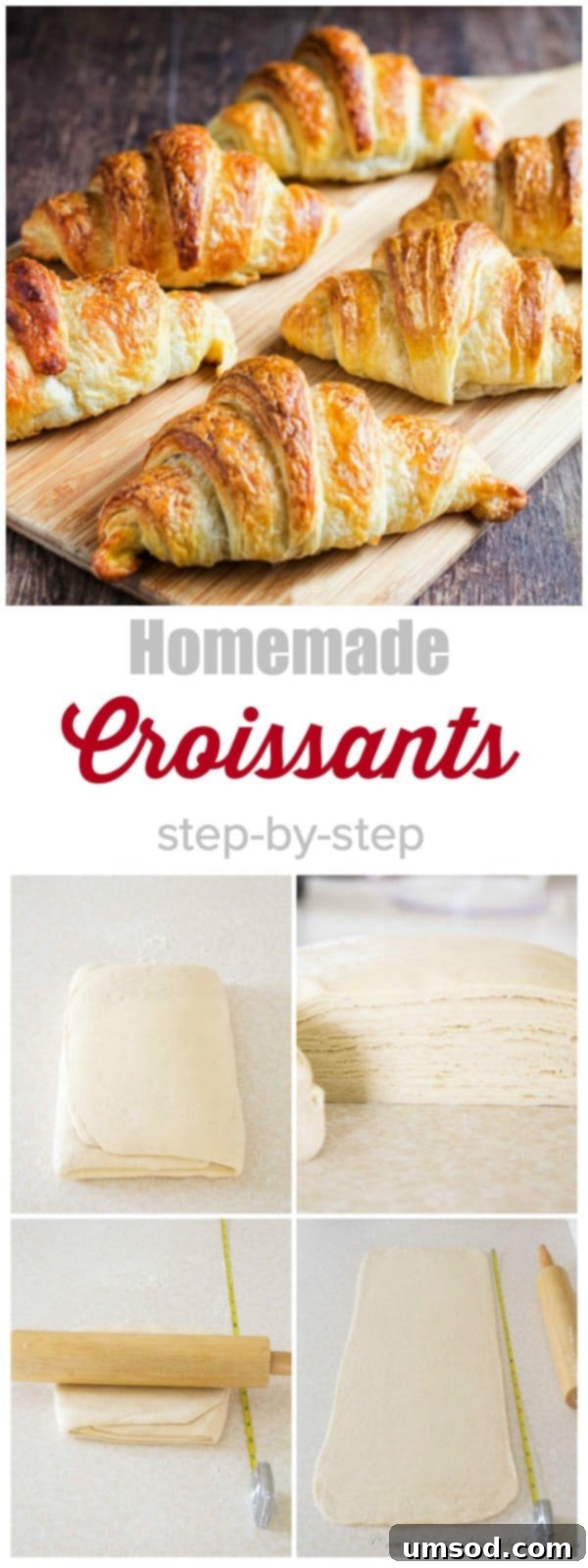
Mastering Homemade Croissants: Your Step-by-Step Guide to Flaky Perfection
There’s an unparalleled joy in biting into a freshly baked croissant. That magical moment when the crisp, golden crust gives way to a tender, cotton-soft interior, each layer imbued with rich, exquisite butter. This isn’t just a pastry; it’s an experience. While the thought of making croissants from scratch might seem daunting, reserved only for seasoned patisserie chefs, I’m here to tell you it’s an incredibly achievable and deeply rewarding journey for any home baker. The result? Light, airy, and ultra-buttery croissants that don’t just taste divine, but also fill you with an immense sense of accomplishment!

The Quest for the Perfect Croissant: My Personal Journey
My adoration for croissants runs deep, a true weakness that I’ve long indulged. However, the reality of my location presented a significant hurdle: there isn’t a single bakery nearby that crafts truly amazing croissants. In fact, there isn’t a bakery in town at all! This culinary void meant that authentic, flaky croissants were a rare luxury, typically enjoyed only during travels.
This scarcity ultimately sparked a personal mission. I distinctly remember a work trip to San Antonio, Texas, in October 2013. As I savored a truly exceptional croissant at the hotel breakfast, I made a silent promise to myself: I would never buy another croissant until I learned to bake them perfectly at home. While I confess to a minor lapse (the allure of a favorite Minneapolis bakery’s croissant proved too strong once!), that pledge ignited my passion. It wasn’t long before I successfully produced a batch of homemade croissants that were nothing short of fabulous. The gratification was immense!

Demystifying Croissant Baking: Patience Over Difficulty
I won’t mislead you; making croissants isn’t as simple as whipping up a batch of cookies. It’s a commitment that requires patience, a bit of focused attention, and a willingness to follow steps. But is it genuinely “difficult”? Not in the way you might imagine. The ingredients themselves are common kitchen staples, and the techniques, while precise, are easily mastered with careful guidance.
The true characteristic of croissant baking lies in its multi-day process. This isn’t about constant labor but rather structured resting periods that allow the dough to develop properly. You’ll dedicate your undivided attention for short bursts over three days, culminating in a spectacular reward. My first successful batch was baked on April 20th, 2014, and within a month, I enthusiastically made three more. Each attempt deepened my understanding and proficiency, transforming a once intimidating task into a thoroughly enjoyable culinary art. And, let’s be honest, continuously eating warm, buttery croissants is hardly something to complain about!

The universal truth in cooking and baking is that homemade from scratch always tastes superior, and croissants are no exception. The symphony of flavors and textures – the incredibly flaky crust, the cotton-soft interior, the gorgeous golden color, and that unmistakable buttery fragrance of fresh-baked pastry – simply cannot be replicated by mass production. There’s nothing quite like the immense feeling of achievement when you admire your picture-perfect croissants, knowing every delicate layer was crafted by your own hands.
Your 3-Day Croissant Journey: A Detailed Overview
Are you ready to create your own edible masterpieces? I’ve meticulously outlined the entire process with step-by-step instructions and photographs to guide you. While it spans three days, please don’t let that discourage you. The active working time is surprisingly manageable, making it a perfect weekend baking project that yields extraordinary results.
- Day 1: The Foundation – Less than 30 minutes active time
This initial phase is designed to be quick and easy. You’ll prepare the basic dough and your butter block, allowing them to chill and develop overnight in the refrigerator. This crucial resting period primes the dough for the intricate layering to come and ensures your butter is at the ideal consistency. - Day 2: The Art of Lamination – The most hands-on day
This is where the magic truly unfolds. You’ll integrate the butter into the dough through a series of precise rolling and folding techniques, creating the countless delicate layers characteristic of classic croissants. Each “turn” is followed by a vital 30-minute rest, allowing the dough’s gluten to relax and preventing the butter from becoming too warm. - Day 3: Shaping, Proofing, and Baking – The Grand Finale
On the final day, you’ll perform one last gentle roll, revealing the beautiful stratification you’ve meticulously built. Then, it’s time to skillfully shape your croissants, allowing them to proof until light and airy, and finally, baking them to a glorious golden perfection. Before you know it, you’ll be savoring the irresistible aroma and taste of your homemade buttery delights.

Detailed Step-by-Step Instructions for Perfect Croissants
DAY 1: Dough Preparation & Butter Block Creation
Day 1 is your gateway to incredible croissants, focusing on building the foundation. Begin by combining all your dough ingredients – flour, milk, sugar, softened butter, instant yeast, and salt – in a large mixing bowl. If you have a stand mixer with a dough hook, use it for effortless kneading. Otherwise, a bit of hand-kneading will achieve the same smooth, elastic consistency in about 5-7 minutes. Once properly kneaded, gently shape the dough into a flat disk. Place it in a lightly floured bowl, cover it tightly with plastic wrap to prevent a skin from forming, and refrigerate for a minimum of 6 hours, or ideally, overnight. This slow, cold fermentation not only enhances the flavor but also conditions the dough, making it much easier to handle for lamination.
Simultaneously, prepare your butter block for the lamination process. Take 1 cup (225gr) of cold, but pliable, unsalted butter. Place it between two large sheets of parchment paper. Using a rolling pin, roll the butter into a precise 7×7 inch (18×18 cm) square. If the edges are uneven, simply trim them and place the trimmings on top of the main butter block, then re-roll to achieve a perfectly uniform square. This precision is vital for even layers. Once shaped, refrigerate the butter block for at least 30 minutes, or overnight, ensuring it remains cold but flexible. A crucial tip: resist the temptation to freeze the butter to expedite this step! Frozen butter will be too brittle and will crack and break into your dough during rolling, ruining the delicate layers. Cold but pliable is the key.
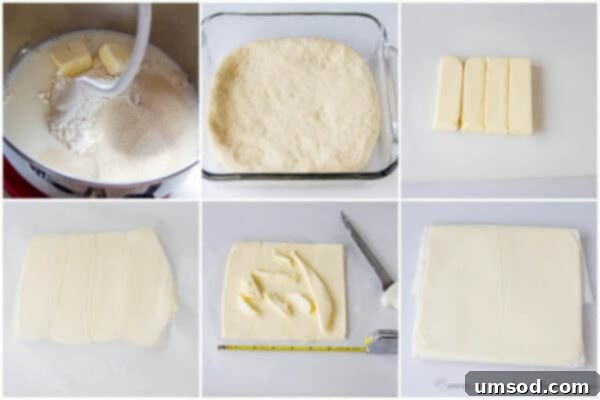
DAY 2: Lamination – Building Those Irresistible Layers
Welcome to the heart of croissant making: lamination! This is the process of creating hundreds of alternating layers of dough and butter, which ultimately yield that iconic flaky texture. Don’t be intimidated by the term; it’s a rhythmic process that becomes intuitive after the first turn.
Retrieve your chilled dough from the refrigerator. On a lightly floured surface, gently roll it into a 10×10 inch (25×25 cm) square. While exact measurements aren’t critical, aim for a relatively even square. Now, retrieve your butter block and place it diagonally in the center of the dough square. Carefully fold the four corners of the dough over the butter, meeting them precisely in the center to fully encase the butter. Pinch the seams firmly to create a sealed package, preventing any butter from escaping during the rolling process.
Next, perform your first “turn.” With gentle, even pressure, roll the dough package into an 8×24 inch (20×60 cm) rectangle. Focus on maintaining a consistent thickness throughout the rectangle. Once rolled, visually divide the rectangle into three equal sections and fold one end over the middle section, then fold the other end over that, just like you would fold a business letter. This creates three distinct layers of dough and two layers of butter. Wrap the folded dough tightly in plastic wrap and refrigerate for exactly 30 minutes. This rest period is crucial: it allows the gluten in the dough to relax, making it easier to roll the next time, and ensures the butter remains firm and cold.
You will repeat this rolling and folding process (a “turn”) two more times, each followed by a 30-minute refrigeration. In total, you’ll complete three turns. Remember, if at any point the dough becomes too elastic or resistant, or if the butter feels like it’s softening too much, simply return the dough to the refrigerator for an extra 10-15 minutes to chill before proceeding. Patience here is key to achieving those distinct, beautiful layers. After the third turn, wrap the dough securely and refrigerate it overnight (for at least 6-8 hours) for its final rest.
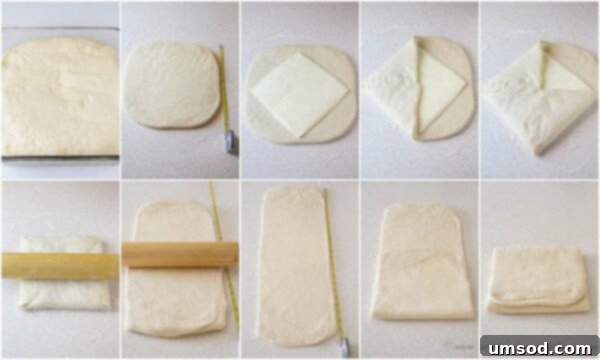
DAY 3: Shaping, Proofing, and Baking Your Croissants
The final day is the most exciting, as you’ll see your diligent efforts come to fruition. Remove the thoroughly chilled dough from the refrigerator. If your countertop isn’t expansive enough to handle a very long sheet of dough, it’s perfectly fine (and often easier) to cut the dough into two equal parts. On a lightly floured surface, roll each portion (or the single piece) into a long, even rectangle. Aim for an 8×22 inch (20×55 cm) rectangle for each half, or an 8×44 inch (20×110 cm) rectangle if working with one piece. As you roll, notice the incredible visible layers you’ve created – these are the delicate strata that will puff up in the oven to give your croissants their signature flakiness!
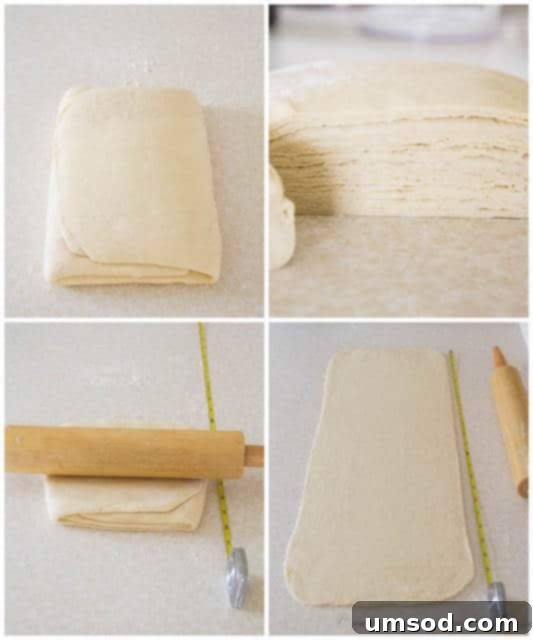
Once rolled, it’s time to shape your croissants. Using a ruler and a sharp pizza cutter or knife, mark the dough. On both long sides of your rectangle, make marks every 5.5 inches (14 cm). Connect these marks with diagonal cuts to form triangles. This method should yield approximately 16 large, perfectly proportioned triangles. Before rolling, you can slightly stretch one corner of each triangle to create a more defined point, which aids in forming that classic crescent shape. Make a small slit, about ½ inch (1.5 cm), at the wide base of each triangle. Then, gently roll each triangle from the base towards the tip, softly curving the ends to form the traditional croissant shape. For an irresistible variation, consider placing a few chocolate squares (for pain au chocolat) or a dollop of Nutella at the wide base before rolling.
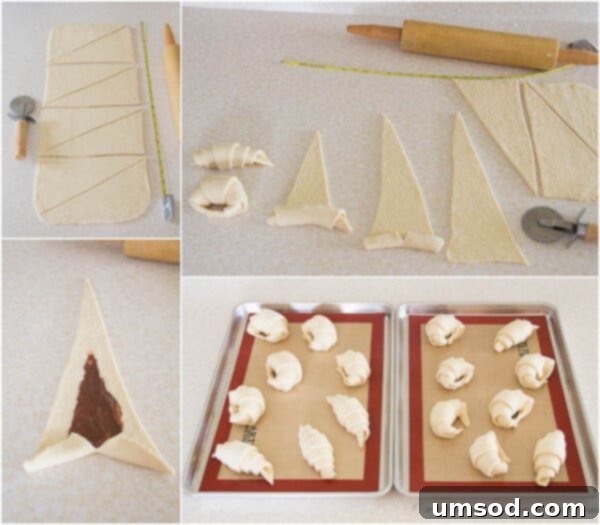
Place your shaped croissants on baking sheets lined with parchment paper or silicone mats, ensuring ample space between each for expansion. Now for the critical “proofing” stage: loosely cover them with plastic wrap or a clean kitchen towel and let them rise in a warm, draft-free environment for approximately 1 to 1.5 hours. During this time, the yeast activates, and the croissants will visibly puff up, becoming significantly larger and feeling delicate and airy to the touch. Proper proofing is absolutely essential for achieving that characteristic open, airy crumb structure inside. Do not rush this step!
As your croissants finish proofing, preheat your oven to 425°F (220°C). In a small bowl, whisk one large egg with a tablespoon of water to create an egg wash. Gently brush the tops of the proofed croissants with this wash; it will give them that gorgeous, glossy golden sheen as they bake. Bake for 20-25 minutes, rotating the baking sheets halfway through to ensure even browning. Keep a close eye on them until they are a deep, rich golden brown and look utterly irresistible. Serve them warm, ideally within minutes of coming out of the oven, to experience their delicate texture and rich buttery flavor at its peak. You’ve done it!

Expert Tips for Croissant Success
- Maintain Cold Temperatures: This is arguably the most critical factor. Ensure your butter and dough remain as cold as possible throughout Day 2, especially during lamination. If the butter melts into the dough, you’ll lose those distinct, flaky layers. Work quickly and efficiently, and don’t hesitate to return the dough to the fridge if it feels too warm.
- Invest in Quality Butter: The flavor of your croissants heavily depends on the butter. Use high-quality unsalted butter with a higher fat content (often labeled “European-style” butter) for the richest flavor and best lamination results.
- Respect the Rest Periods: The refrigeration times between turns are non-negotiable. They allow the gluten to relax, making the dough pliable and preventing it from tearing. They also keep the butter firm, ensuring it remains a distinct layer within the dough.
- Gentle Handling: Always handle the dough with a light touch. Overworking it or being too rough can develop too much gluten, leading to tough croissants rather than light and airy ones.
- Even Rolling is Essential: Strive for consistent thickness when rolling out the dough during each turn. Uneven thickness will result in uneven layers and a less uniform bake.
- Perfect Proofing: Proper proofing is crucial. Underproofed croissants will be dense and won’t rise properly, while overproofed ones might collapse in the oven. Look for a visibly puffed-up appearance and a delicate, jiggly feel when gently shaken.
- Accurate Oven Temperature: Ensure your oven is accurately preheated to the specified temperature. A hot oven creates the necessary steam from the butter layers, which helps them separate and puff up, contributing to the crisp exterior.
Storage and Freezing Instructions
For the ultimate experience, homemade croissants are best enjoyed warm, straight from the oven. If you happen to have any leftovers, store them in an airtight container at room temperature for up to 2 days. To refresh them, a quick warm-up in a preheated oven (around 300°F/150°C) for a few minutes will bring back some of their original crispness.
Freezing Unbaked Croissants for Future Enjoyment: This is a fantastic strategy for having freshly baked croissants on demand! After you’ve shaped your croissants (following Step 9 in the instructions), instead of proofing them, simply place them on a baking sheet and freeze them for at least 3 hours, or until they are completely solid. Once frozen, transfer them to a freezer-safe ziplock bag or an airtight container. They can be stored in the freezer for up to one month without compromising quality.
Baking Frozen Croissants: To bake your frozen croissants, arrange them on a parchment-lined baking sheet. Cover them loosely with a kitchen towel and allow them to thaw and proof overnight at room temperature (this typically takes 8-12 hours). By morning, they should be visibly puffed up and feel light and delicate, indicating they are ready. At this point, you can proceed with the egg wash (Step 11) and baking instructions (Step 12) as outlined in the Day 3 section.
We genuinely hope you’ll embark on this delightful baking adventure and experience the immense satisfaction of making these beautiful, buttery croissants. The effort, while spread out, is truly minimal compared to the incredible reward you’ll reap. Happy baking!

Homemade Croissants Recipe
Comment
Print Recipe
Ingredients
For the Dough:
- 4 cups (500gr) all-purpose flour
- 1 ¼ cup (300ml) milk, at room temperature
- ¼ cup (50gr) granulated sugar
- 2 tablespoons unsalted butter softened
- 1 tablespoon instant yeast
- 1 ½ teaspoons salt
For Lamination (Butter Block):
- 1 cup (225gr) unsalted butter (cold, but pliable)
For Egg Wash:
- 1 large egg
- 1 tablespoon water
Instructions
Day 1: Preparing the Dough and Butter Block
-
In a large mixing bowl (or stand mixer with a dough hook), combine the all-purpose flour, milk, sugar, softened unsalted butter, instant yeast, and salt for the dough. Mix on low speed (or knead by hand) until the dough comes together and is smooth and elastic, approximately 5-7 minutes.
-
Transfer the dough to a lightly floured surface, knead briefly for about a minute. Shape it into a flat disk, place it in a lightly floured dish, cover tightly with plastic wrap, and refrigerate for at least 6 hours, or preferably overnight.
-
Prepare the butter block for lamination: Place the cold (but pliable) unsalted butter between two large sheets of parchment paper. Roll it out into a 7×7 inch (18×18 cm) square. Trim any uneven edges and place the trimmings on top of the butter, then roll again to create a uniform, flat butter square. Refrigerate this butter block for at least 30 minutes, or overnight, alongside the dough. Ensure it is cold but not frozen solid.
Day 2: Lamination – The Folding Process
-
On a lightly floured surface, roll the chilled dough into a 10×10 inch (25×25 cm) square. Place the 7×7 inch butter block diagonally in the center of the dough square. Fold the corners of the dough over the butter, meeting them in the center to completely enclose the butter, forming an envelope. Pinch the seams securely to prevent butter leakage.
-
Gently roll the dough package into an 8×24 inch (20×60 cm) rectangle. Take care to maintain an even thickness. Fold the rectangle into thirds (like a business letter). Wrap the folded dough tightly in plastic wrap and refrigerate for 30 minutes. This completes the first “turn.”
-
Repeat the rolling and folding process (step 5) two more times, chilling the dough for 30 minutes after each fold. In total, you will perform three turns. If the dough becomes too elastic or resistant at any point, refrigerate it for an additional 10-15 minutes before continuing. After the third turn, wrap the dough and refrigerate overnight (at least 6-8 hours).
Day 3: Shaping, Proofing, and Baking
-
On a lightly floured surface, roll the dough one final time. If your countertop is large, roll the entire dough into an 8×44 inch (20×110 cm) rectangle. If not, divide the dough into two equal portions and roll each into an 8×22 inch (20×55 cm) rectangle. Ensure to lift and gently relax the dough occasionally, as it tends to shrink back.
-
Using a ruler and a pizza cutter or sharp knife, mark the dough every 5.5 inches (14 cm) along both long sides. Cut the dough into smaller rectangles, then cut each rectangle diagonally to create triangles. You should yield 16 triangles in total.
-
To shape, slightly stretch one corner of each triangle to create a more pointed tip. Make a small slit (approx. ½ inch or 1.5 cm) at the wide base of each triangle. Gently roll the triangle from the base towards the tip, curving the ends slightly to form the classic crescent shape. (Optional: For chocolate croissants, place a few chocolate squares or a dollop of Nutella at the wide base before rolling.)
-
Place the shaped croissants on baking sheets lined with parchment paper or silicone mats, leaving ample space between them. Cover loosely with plastic wrap or a kitchen towel and let them proof in a warm, draft-free place for about 1 to 1.5 hours, or until they have visibly puffed up and feel light and delicate.
-
Preheat your oven to 425°F (220°C).
-
In a small bowl, whisk the egg with 1 tablespoon of water to create an egg wash. Gently brush the tops of the proofed croissants with the egg wash.
-
Bake for 20-25 minutes, or until the croissants are beautifully golden brown and flaky. Rotate the baking sheets halfway through for even baking. Serve warm and enjoy your homemade masterpieces!
⭐️ Loved this recipe?
Please leave a review and let us know how you liked it!
Tips & Notes
- Store baked croissants in an airtight container at room temperature for up to 2 days. Reheat briefly in a warm oven for best results.
- Freezing instructions (unbaked): After shaping the croissants (Step 9), place them on a baking sheet and freeze for at least 3 hours, or until completely solid. Once frozen, transfer them to a freezer-safe ziplock bag or airtight container. They can be frozen for up to a month.
- To bake frozen croissants: Arrange frozen croissants on a parchment-lined baking sheet. Cover loosely with a kitchen towel and let them thaw and proof overnight (8-12 hours) at room temperature. Once thawed and proofed, continue with Step 11 (egg wash) and Step 12 (baking).
Nutrition (Per Croissant – estimate)

This comprehensive guide to homemade croissants was originally published on May 26th, 2014, and has been thoroughly updated and expanded for clarity, detail, and SEO optimization.