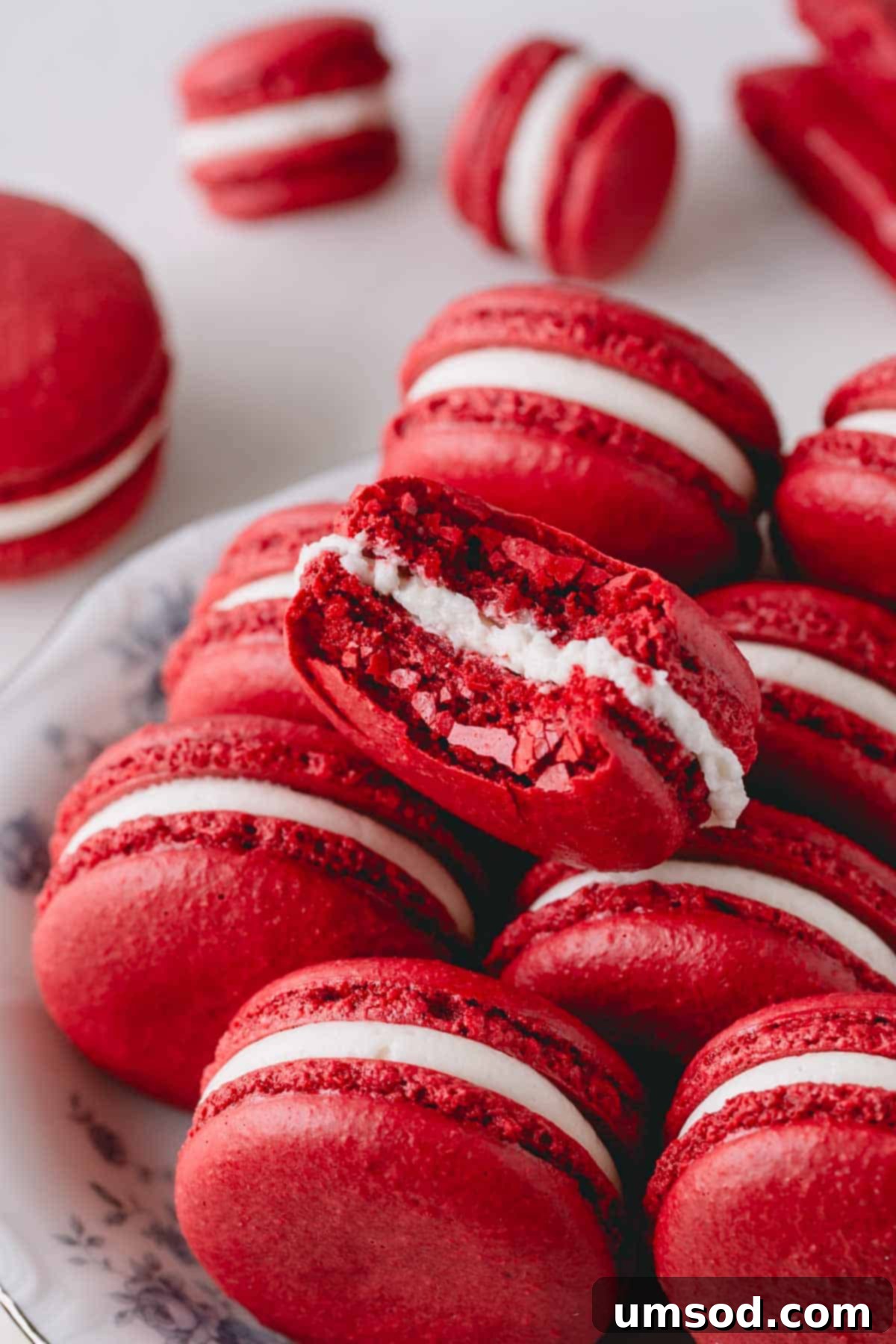
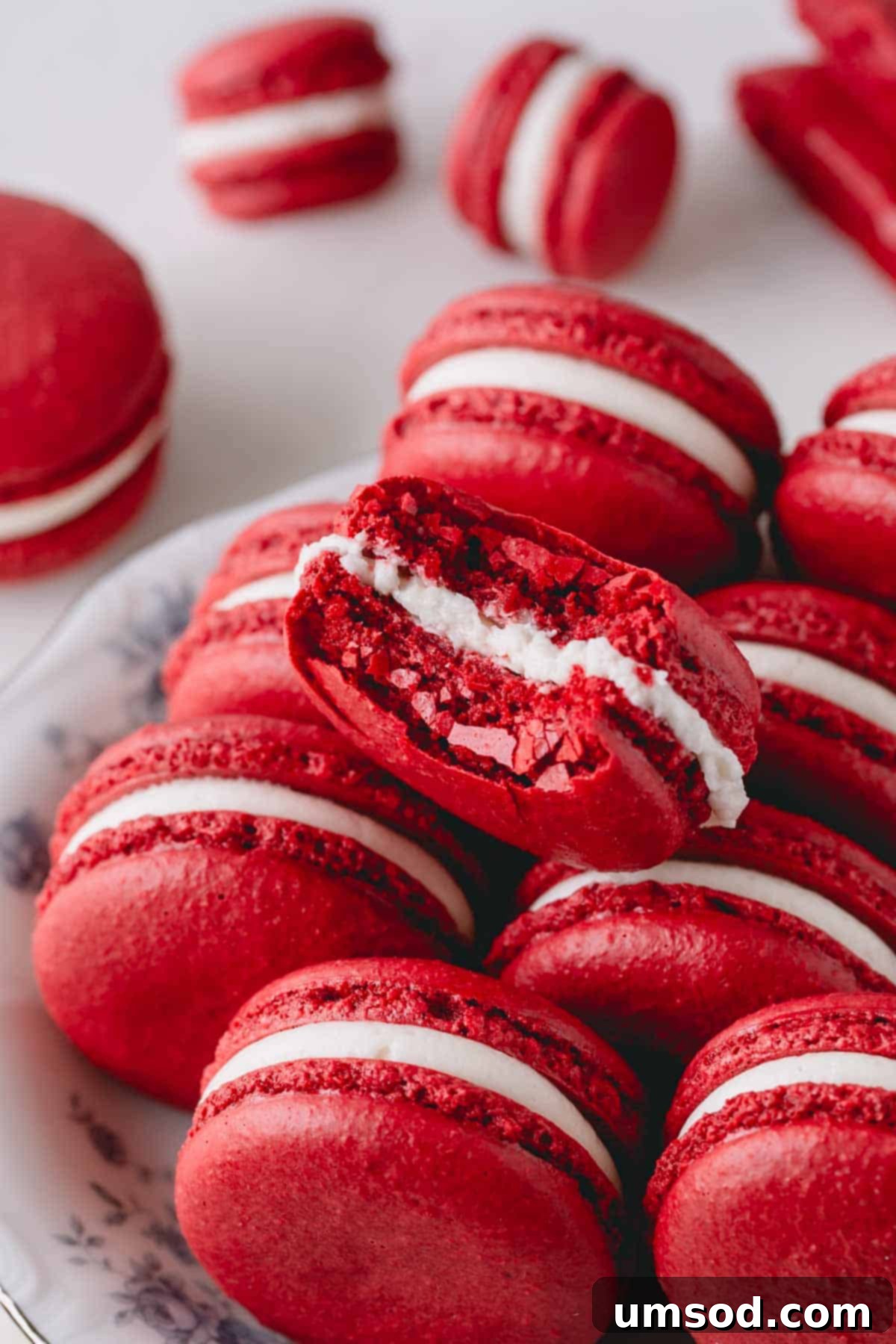
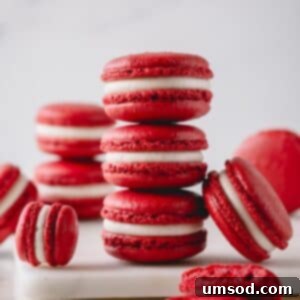
Indulge in the exquisite charm of these stunning **Red Velvet Macarons**, a true masterpiece for any dessert table. Each delicate shell boasts a vibrant, deep red hue and a perfectly crisp-chewy texture, encasing a luscious, tangy-sweet cream cheese frosting. This comprehensive guide will equip you with all the secrets to mastering these impressive treats, from achieving that iconic color to perfecting their delightful consistency. Get ready to elevate your baking skills and impress everyone with these gorgeous, flavorful French macarons!
Why You’ll Fall in Love with Red Velvet Macarons
Red Velvet Macarons consistently rank among the most sought-after and beloved macaron flavors, often rivaling classics like pistachio macarons and refreshing lemon macarons. But what makes them truly irresistible?
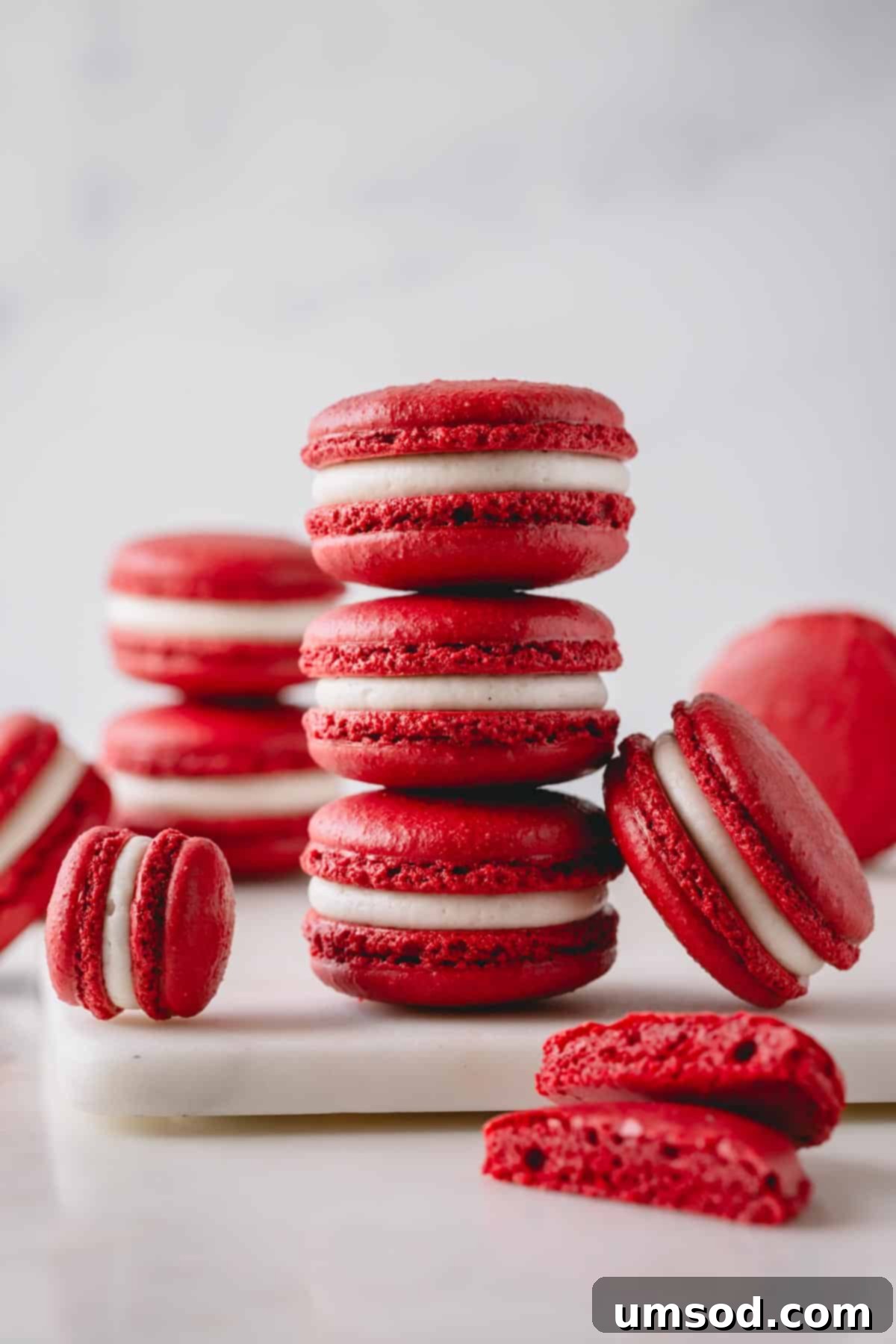
Firstly, it’s their visual appeal. The captivating, deep red color of the shells is simply breathtaking, making them an instant showstopper at any gathering. This isn’t just any red; it’s the rich, luxurious red velvet shade that promises elegance and a touch of romance.
Beyond their stunning appearance, the flavor profile is utterly divine. Each bite offers a harmonious blend of textures and tastes: a crisp exterior giving way to a pleasantly chewy interior, with subtle hints of cocoa and vanilla dancing on your palate. This delicate shell perfectly complements the star of the show – the sweet yet tangy cream cheese filling. The creamy, rich frosting provides the perfect counterpoint to the macaron’s lightness, creating a balanced and unforgettable dessert experience. It’s truly a combination that leaves you craving more!
Is This Red Velvet Macaron Recipe Right for Your Skill Level?
For those embarking on their macaron-making journey, especially if your goal is achieving that flawless, “perfect” macaron aesthetic from the start, this particular recipe might be a bit ambitious for your very first attempt. Crafting Red Velvet Macarons involves a couple of nuanced steps that add a layer of complexity.
The addition of cocoa powder alters the consistency of the dry ingredients, requiring a precise macaronage technique. Furthermore, achieving the signature vibrant red color necessitates a significant amount of gel food coloring, which can also slightly impact the batter’s texture. These factors make the recipe slightly more advanced than basic macaron recipes.
If you’re new to macarons, I highly recommend starting with my beginner-friendly French macaron recipe. It meticulously covers all the fundamental details, explains essential techniques for consistent success, and includes a helpful video tutorial. Once you’ve mastered the basics and built confidence with a foundational recipe, you’ll find tackling these exquisite Red Velvet Macarons much more rewarding and achievable.
Unlock Your Macaron Potential! Explore my entire MACARON ARCHIVE, packed with invaluable resources, expert tips, and beginner-friendly guides to help you master French macarons!
Key Ingredients for Perfect Red Velvet Macarons
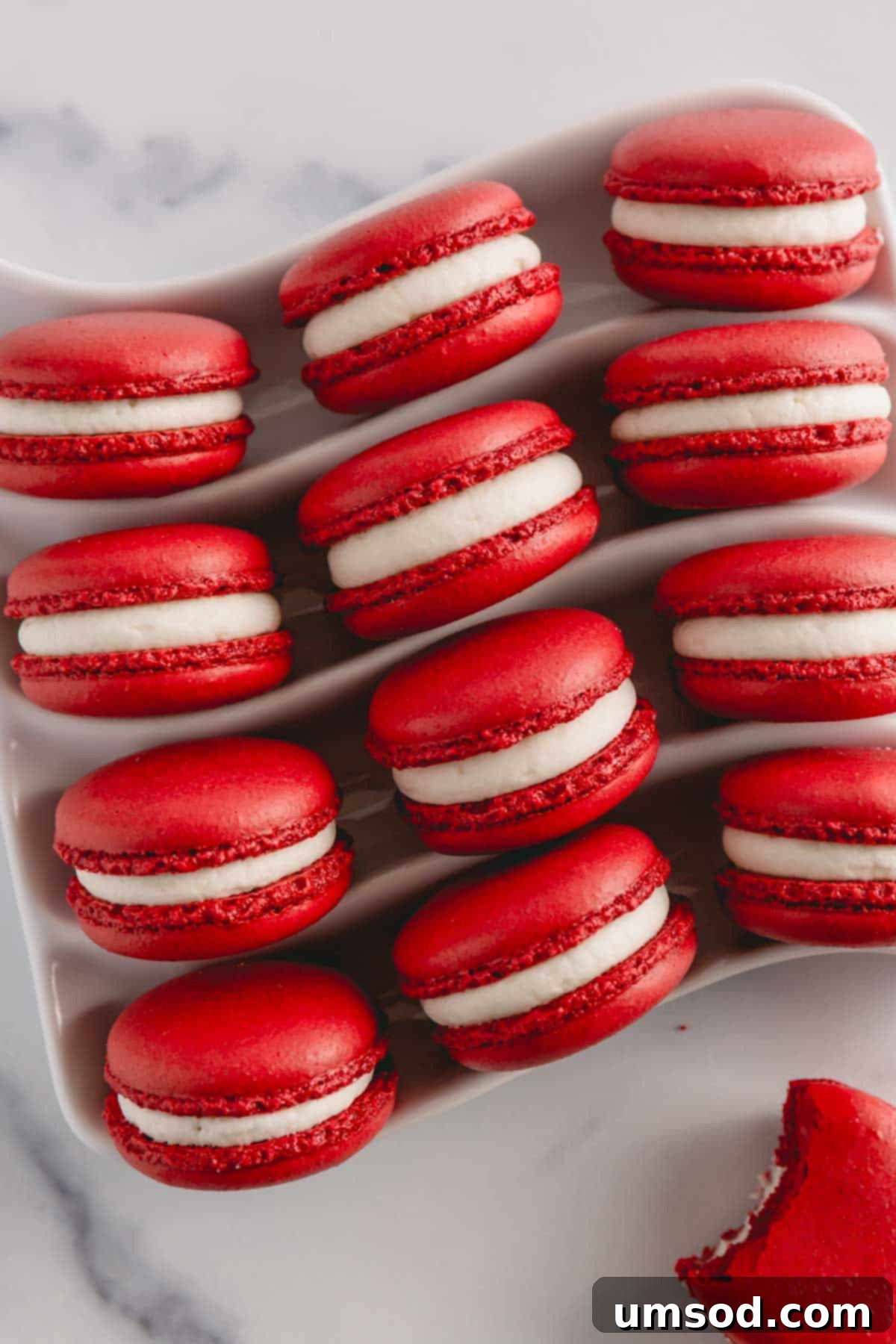
Precision is paramount in macaron baking. To maximize your chances of success, it is absolutely essential to measure all macaron ingredients in grams using a reliable kitchen scale. This intentional step eliminates guesswork and ensures accurate ratios, which are crucial for the delicate balance required in macaron batter.
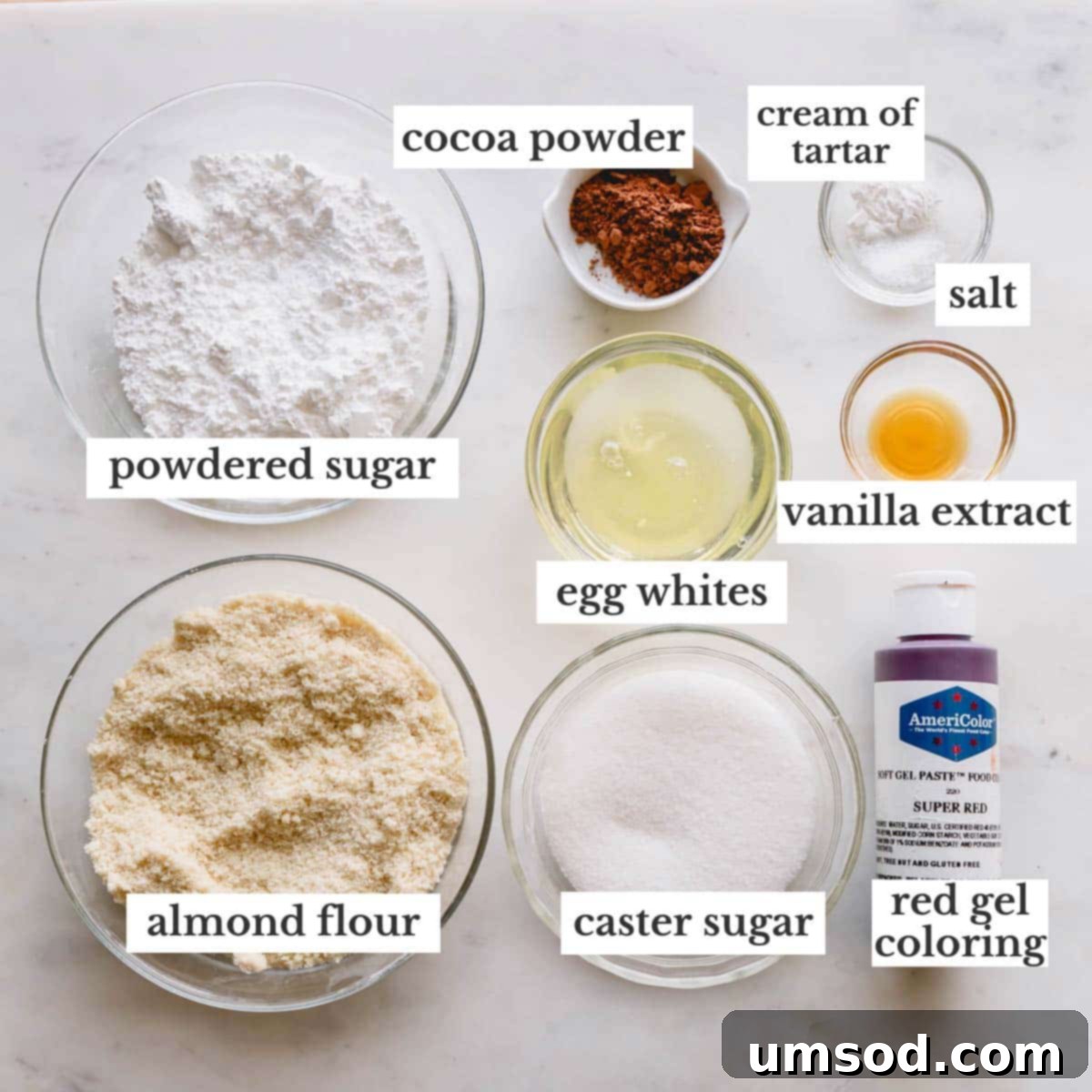
- Egg Whites: The foundation of a stable meringue and, consequently, perfect macaron shells, lies in the quality of your egg whites. Opt for fresh eggs, and carefully separate the whites from the yolks to avoid any fatty contaminants. Weighing the exact amount of egg whites is non-negotiable. While fresh eggs are ideal, I’ve also had success with carton egg whites; just be sure to check labels and avoid those marked “not for meringue” as they may contain additives that inhibit whipping. Room temperature egg whites are also recommended for optimal meringue volume and stability.
- Almond Flour: The secret to smooth macaron tops is super-fine almond flour. Look for a product with a light beige color and a fluffy texture. Steer clear of oily, yellowish, or coarse almond flour, as these can negatively impact the final texture and appearance of your shells. This almond flour is a trusted choice that consistently delivers excellent results.
- Powdered Sugar (Confectioners’ Sugar): While tempting, I do not recommend making your own powdered sugar for macarons. Commercial powdered sugar typically contains a small amount of cornstarch, which plays a vital role in preventing clumping and helps contribute to the desirable crisp yet tender texture of the macaron shells.
- Granulated Sugar: For the meringue, it’s important to use **fine** granulated sugar. Its finer crystals dissolve more quickly and evenly into the egg whites, ensuring a smooth and stable meringue. Caster sugar, also known as baker’s sugar, is an excellent alternative due to its similar fine consistency.
- Cocoa Powder: This ingredient serves a dual purpose in our red velvet macarons. It adds a delightful hint of chocolate flavor, enhancing the classic red velvet taste, and crucially, it deepens the red color of the shells, helping to achieve that intense, rich hue. You can use either natural or Dutch-processed unsweetened cocoa powder, both will contribute to the desired color and flavor.
- Cream of Tartar: This ingredient is technically optional but highly recommended. It acts as a stabilizer for the egg whites, helping them whip up faster and creating a sturdier, more resilient meringue. Think of it as an extra layer of insurance for macaron success, especially for beginners.
- Red Gel Food Coloring: To achieve that iconic, vibrant red color that defines red velvet, gel food coloring is absolutely essential. Liquid food coloring can introduce too much moisture, throwing off the delicate balance of the macaron batter. Gel coloring provides concentrated pigment without significantly altering the consistency.
Mastering Red Velvet Macarons: A Step-by-Step Guide
We’ll be using the French meringue method for these macarons, which is widely considered the most straightforward technique. While appearing simple, success lies in careful execution of each step. Follow along to create these delectable treats!
1. Prepare and Sift the Dry Ingredients
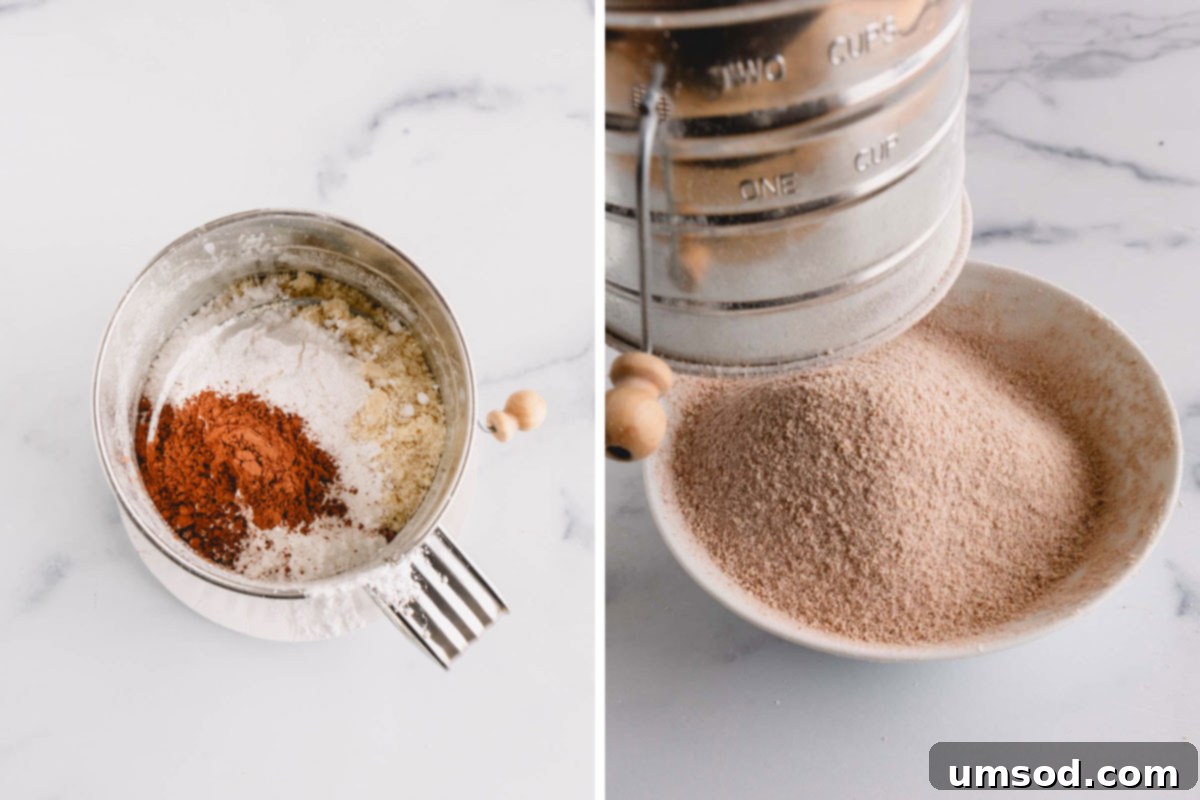
The first critical step involves preparing your dry ingredients: almond flour, powdered sugar, and cocoa powder. It is vital to **sift** this mixture thoroughly, not just once, but ideally three times. This meticulous sifting serves a dual purpose: it ensures all ingredients are perfectly combined, eliminating any lumps, and crucially, it aerates the mixture. Aerating the dry ingredients contributes significantly to lighter, fluffier macaron shells with smooth tops. Don’t skip this step!
TIME-SAVING TIP: If you’re using a stand mixer, you can efficiently sift your dry ingredients while the meringue is whipping. This parallel activity helps streamline the overall macaron-making process.
2. Crafting the Perfect French Meringue
French meringue, as described, is the simplest method, involving whisking egg whites with sugar until stiff peaks form. However, achieving a robust and stable meringue for macarons requires a few key considerations.
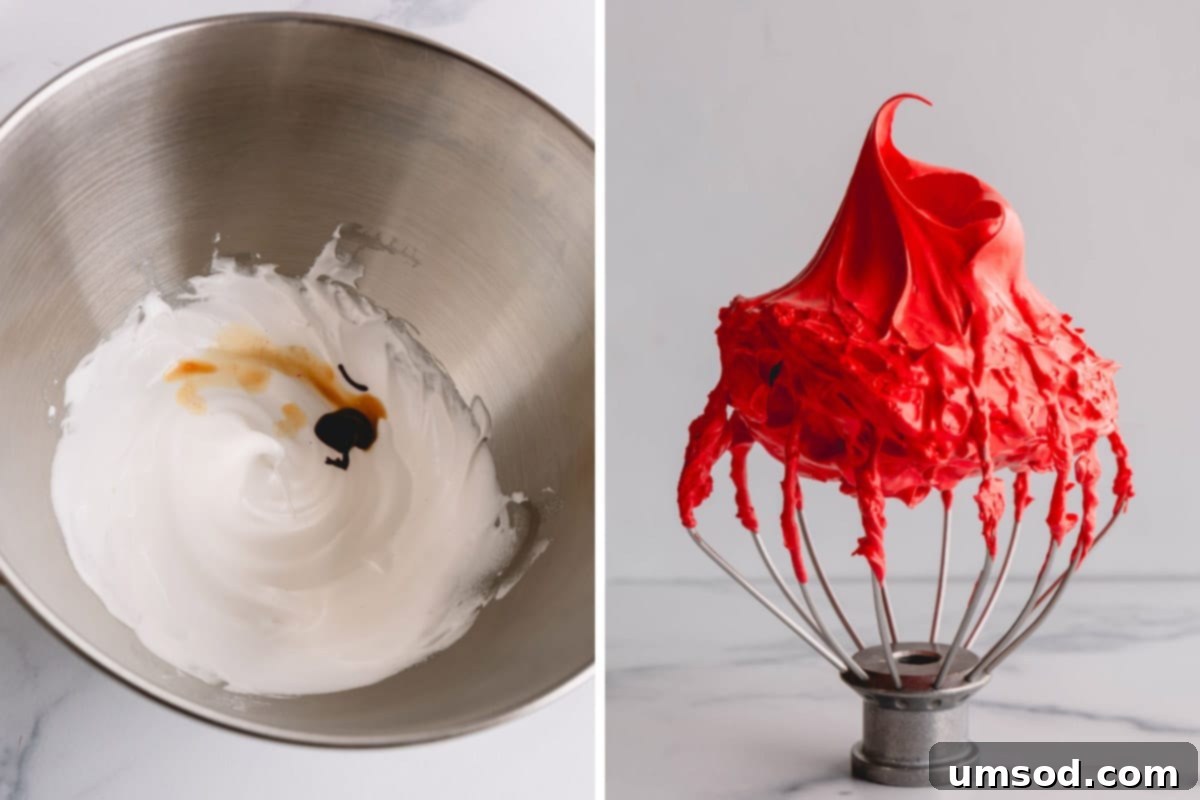
Begin by combining your room temperature egg whites, fine granulated sugar, a pinch of salt, and cream of tartar (if using) in a large, impeccably clean mixing bowl. Using a whisk attachment, **beat** this mixture on a medium-low speed. The goal here is gentle, consistent aeration rather than aggressive whipping. Continue beating until soft peaks begin to form – the mixture will be frothy and hold a slight peak when the whisk is lifted.
At this soft peak stage, **add** your red gel food coloring and vanilla extract. Incorporating it now ensures even color distribution without deflating the meringue too much. Continue beating the mixture at the same medium-low speed until stiff peaks form. You’re looking for a glossy, firm meringue that holds its shape beautifully. When you lift the whisk, the peaks should stand upright and have well-defined ridges, as clearly demonstrated in the image below. This texture indicates a strong, stable meringue capable of supporting the macaron structure.
Meringue Perfection Tip: Slow and Steady Wins the Race
The secret to the sturdiest French meringue lies in a slow and consistent whipping speed. Resist the urge to crank up the mixer to high; rushing this process can create large, unstable air bubbles that collapse easily. While the exact time varies depending on your mixer, be patient. It can take anywhere from 30 to 40 minutes to reach perfect stiff peaks, but this investment of time is crucial for achieving full, airy macaron shells.
2023 TECHNIQUE UPDATE: Over the past year, my French meringue technique has evolved slightly for even better macaron results. Instead of gradually adding sugar to lightly whipped egg whites, I now combine all the egg whites, sugar, salt, and cream of tartar from the very beginning. I’ve consistently found this “all-at-once” approach yields a more stable and reliable meringue, which is essential for consistent macaron success.
3. Mastering the Macaron Batter (Macaronage)
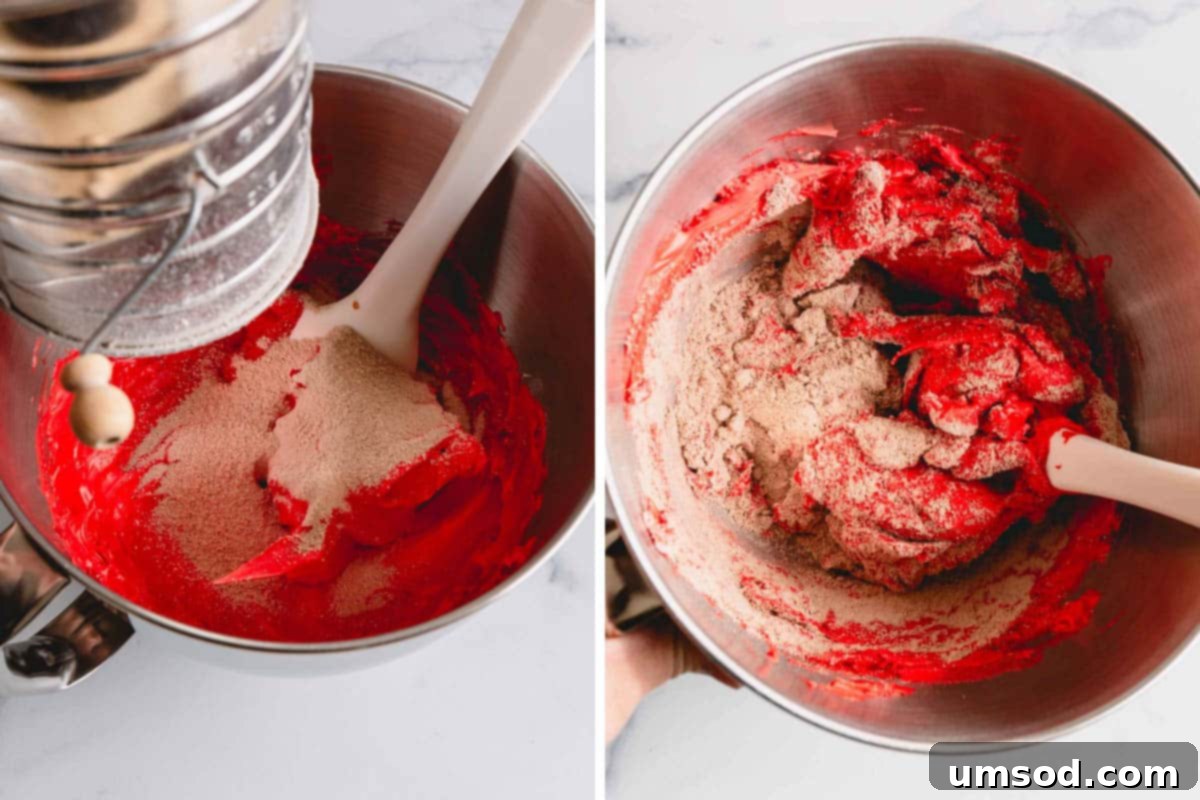
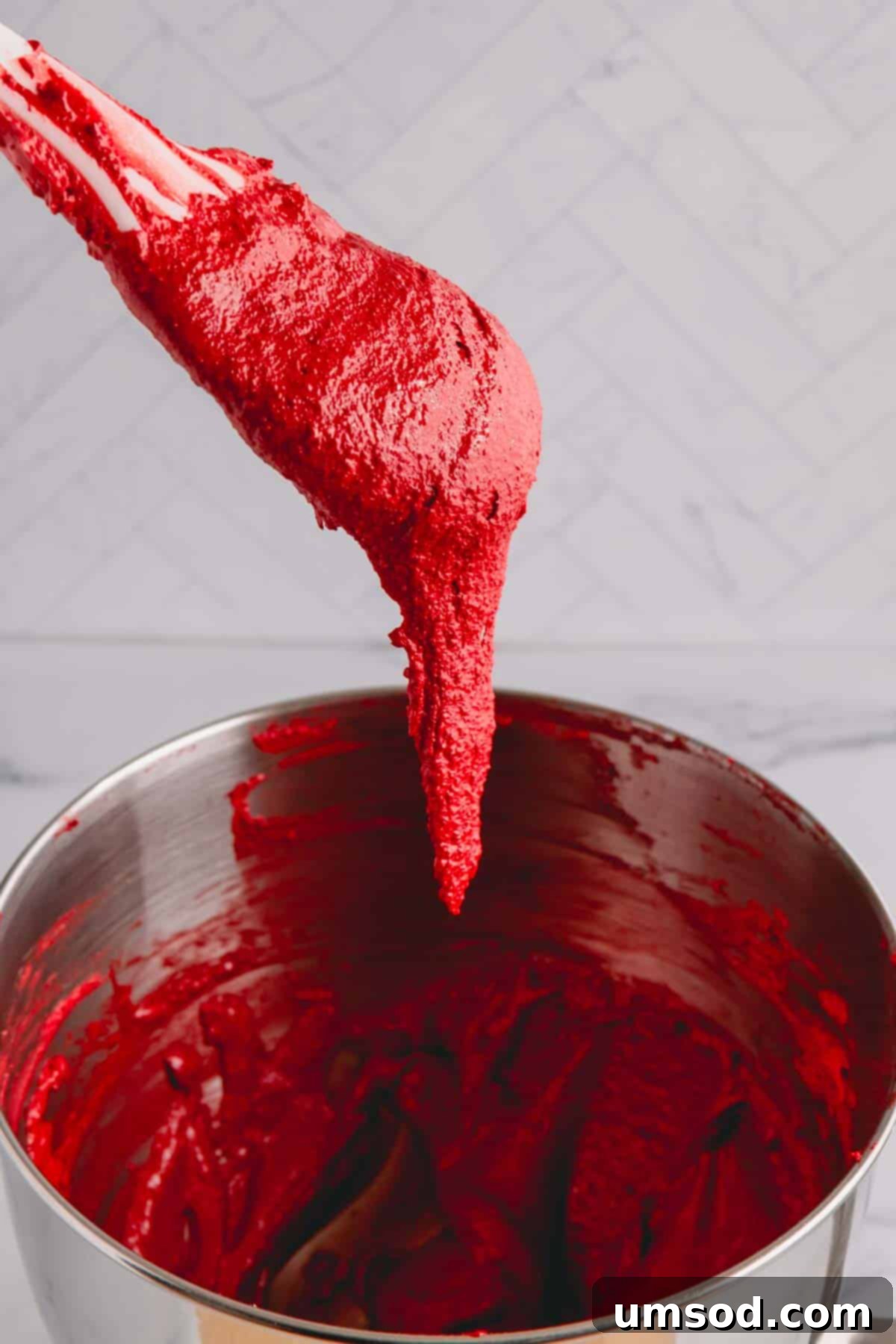
Macaronage is arguably the most critical step, where the dry ingredients are gently folded into the meringue. This process, known as macaronage, determines the final texture and appearance of your shells. Begin by **adding** the sifted dry ingredients into your stiff meringue. Using a silicone spatula, carefully **fold** the batter. The motion should involve scraping down the sides of the bowl, pushing the batter from the bottom up, and gently pressing the mixture to release air. Continue folding until the batter reaches the perfect consistency, often described as a “lava-like” flow. This means the batter should be thick enough to hold some shape, yet fluid enough to slowly flow off your spatula in a continuous ribbon.
How to Confidently Check Macaron Batter Consistency
Mastering macaronage comes down to feel and a simple visual test. Here’s how to ensure your batter is perfectly ready:
- The Ribbon Test: Scoop a generous amount of batter onto your spatula. Let the batter slowly fall back into the bowl, forming a continuous “ribbon.”
- The Count: Slightly tilt the bowl and observe the fallen ribbon. Count to ten.
- The Melt: If the edges of the ribbon gently melt back into the rest of the batter within approximately 10 seconds, your batter has reached the ideal consistency. If it holds its shape too rigidly, fold a few more times and re-test. If it spreads too quickly, it’s likely over-folded.
4. Piping and Baking the Macaron Shells to Perfection
Once your batter has the perfect consistency, it’s time to pipe! **Transfer** the finished macaron batter into a pastry bag fitted with a round piping tip (a Wilton 12 tip is an excellent choice for standard-sized macarons). Prepare two baking sheets by lining them with parchment paper or silicone mats.
Hold the pastry bag vertically, at a straight 90° angle, about half an inch above your lined baking sheet. Apply even pressure to **pipe** uniform, approximately 1.5-inch rounds, leaving about an inch of space between each shell to allow for spreading. After piping, firmly **tap** the baking sheets several times on your counter. This crucial step helps to release any trapped air bubbles within the batter, which can cause hollow or cracked shells. For any stubborn large bubbles, a toothpick can be used to gently pop them, ensuring smooth, blemish-free tops.
Next, **rest** the piped macarons on the counter for about 15-30 minutes, or until a light skin (pellicle) forms. This pellicle is essential for the characteristic “feet” to develop during baking. Finally, **bake** one baking sheet at a time in a preheated oven at 300°F (150°C) for approximately 15-18 minutes. Baking one tray at a time ensures even heat distribution and more consistent results. Keep an eye on them; the exact baking time can vary depending on your oven.
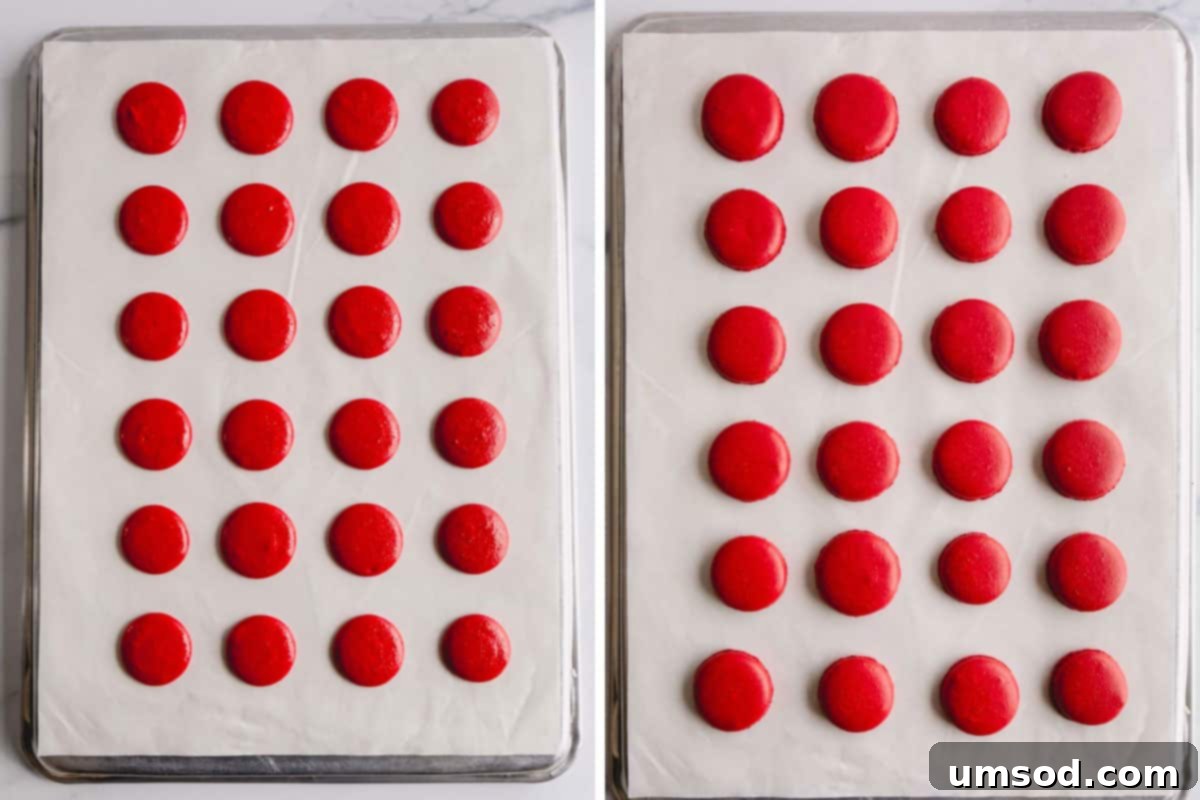
Pro Tip: Utilize a Macaron Template for Uniformity
Achieving perfectly uniform macaron shells can be challenging. To make this easier, I’ve created a custom, printable macaron template that guides your piping. Subscribe to my e-mail list to download this custom macaron template for FREE. This template is designed to work seamlessly with my recipe, making the piping process much simpler and ensuring consistent sizing for all your beautiful shells!
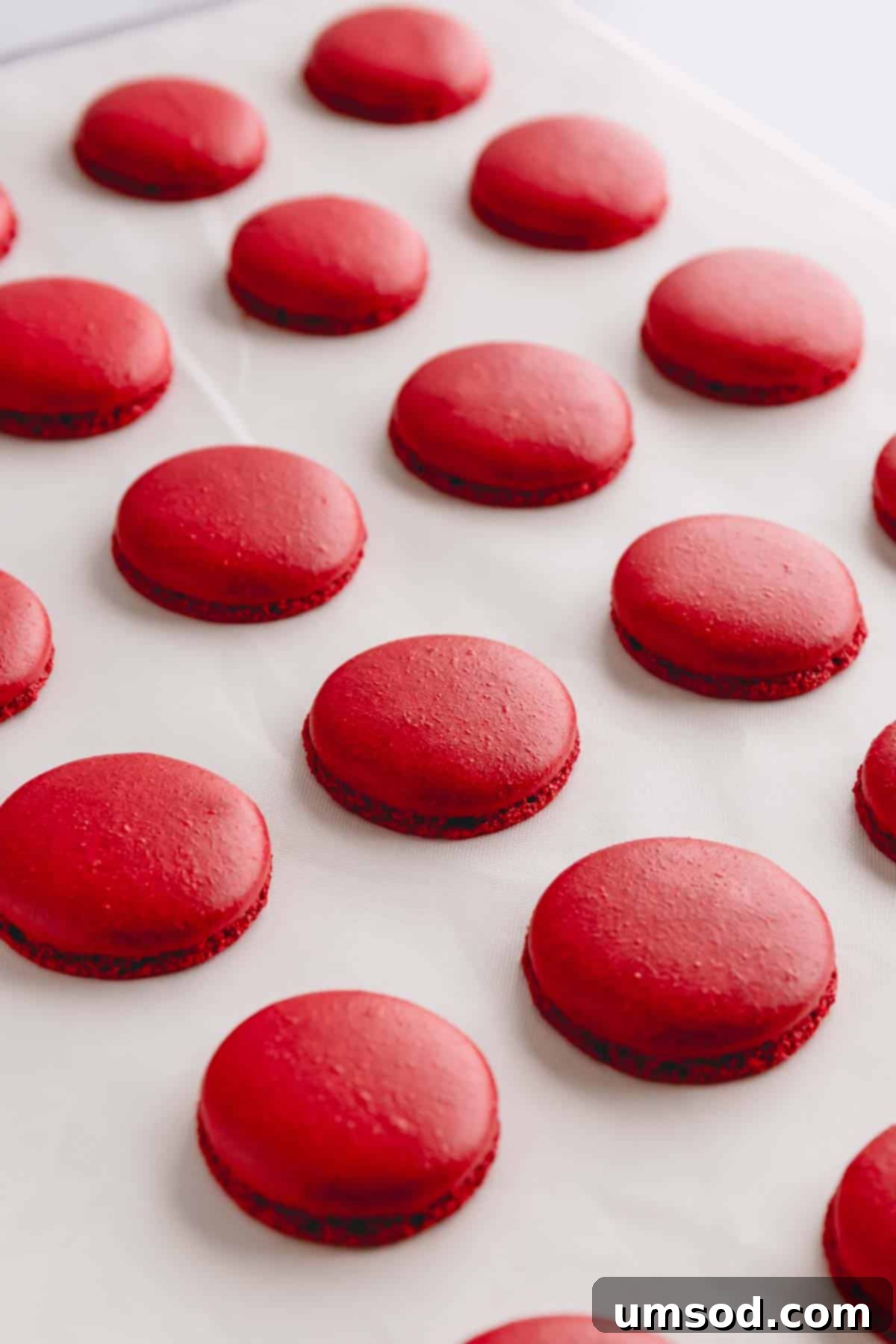
5. Prepare the Tangy Cream Cheese Filling
While your beautifully baked macaron shells are cooling completely, it’s the perfect time to prepare the star filling: a rich and tangy cream cheese frosting. I find that my simple cream cheese frosting recipe works exceptionally well for macarons, offering the ideal balance of sweetness and tanginess that perfectly complements the red velvet shells. It’s stable enough to hold its shape within the delicate cookies yet wonderfully creamy.
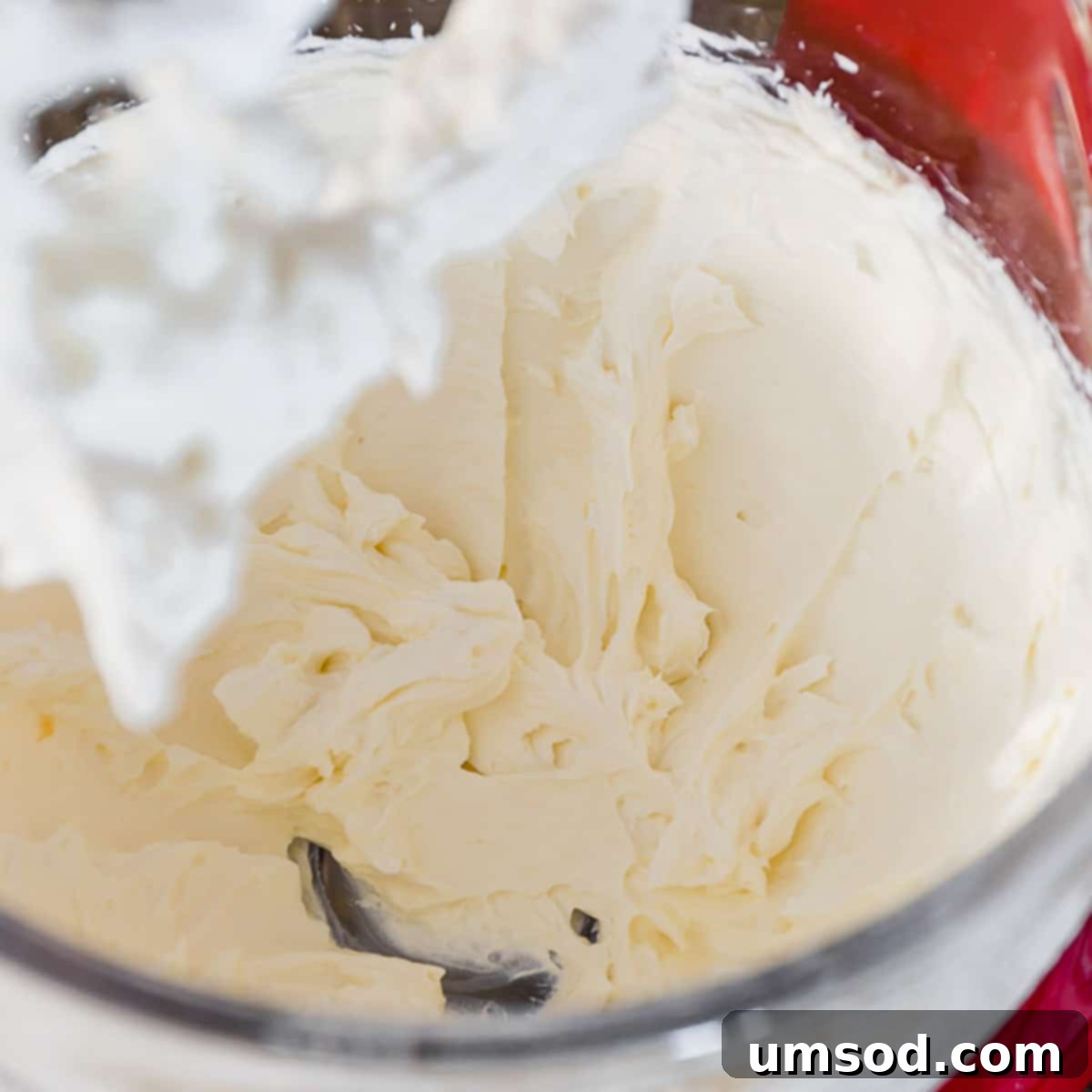
6. Assemble Your Red Velvet Macarons
Once your macaron shells are completely cooled and firm, you can begin the delightful assembly process. First, carefully **remove** the shells from your baking surface. It’s crucial they are cool to the touch, as attempting to remove warm shells can lead to breakage or sticking. Next, **pair** the shells by size, ensuring each top shell matches a similarly sized bottom shell. This creates a neat and professional final product. Finally, **fill** them generously with your prepared cream cheese frosting. Using a piping bag makes this process clean and efficient, allowing for a consistent amount of filling in each macaron.
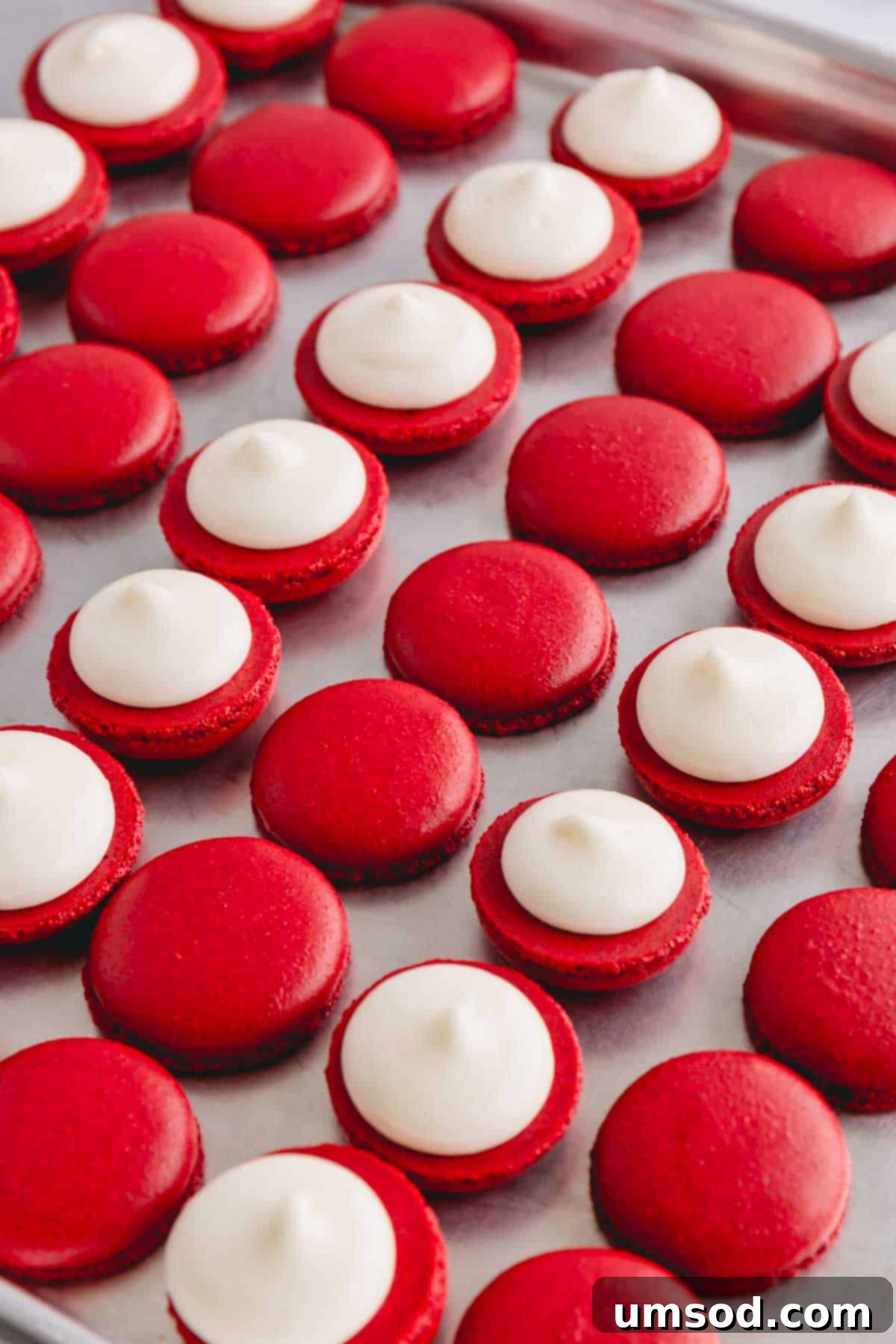
7. The Crucial Maturation Period for Enhanced Flavor and Texture
I understand the temptation to dive right into these beautiful macarons, but patience is a virtue when it comes to macarons! These delightful treats are at their absolute best when allowed to **mature** after being filled. This process involves refrigerating them for at least 8 hours (though longer is often better). During maturation, the moisture and flavors from the cream cheese filling slowly seep into the crisp macaron shells. This magical transformation softens the shells to that signature chewy consistency and infuses them with the delicious tangy-sweet flavor of the filling, creating a perfectly harmonious bite. Don’t skip this step – it truly elevates the macaron experience!
Optimizing Macaron Maturation Time
While many macaron recipes recommend a maturation period of at least 24 hours, our Red Velvet Macarons, with their cream cheese frosting, benefit from a slightly shorter, yet effective, maturation. Because cream cheese frosting is a wetter filling compared to ganaches or buttercreams, it softens the shells more efficiently. Therefore, an 8-hour maturation period in the refrigerator is perfectly sufficient to achieve that desirable tender chewiness and flavor infusion.
Unveiling the Secret to Exceptionally Vibrant Red Macarons
Achieving that intensely vibrant, true red color in your red velvet macarons can be a challenge. Simply adding a large quantity of red food coloring alone often results in shells that appear more pinkish-red rather than the deep, rich hue we associate with classic red velvet. This can be frustrating for any baker!
The true secret to unlocking intensely red macarons lies in a clever combination: utilizing both cocoa powder and red gel food coloring. The cocoa powder, even in a small amount, provides a deep, earthy base. This subtle brown undertone acts as a catalyst, allowing the red gel food coloring to truly pop and achieve a more profound, vibrant red. Without the cocoa powder, the red pigment struggles to reach its full potential, resulting in a lighter shade. Together, they create a synergistic effect, delivering the stunning, rich red velvet color you desire.
Crucial Tip: Always Choose Gel Food Coloring for Macarons
When it comes to coloring macaron batter, the type of food coloring you use is paramount. Always opt for **gel food coloring** over liquid varieties. Liquid food coloring contains water, and introducing additional moisture can disrupt the delicate wet-to-dry ingredient ratio of the macaron batter, leading to an unstable meringue and failed shells. Gel coloring, being highly concentrated, allows you to achieve vivid hues with minimal liquid, preserving the integrity of your batter. For these Red Velvet Macarons, I highly recommend Americolor Super Red gel food coloring for its exceptional vibrancy and reliability.
Optimal Storage for Macarons: Keeping Them Fresh and Delicious
Proper storage is essential to maintain the delicate texture and fresh flavor of your homemade Red Velvet Macarons. Here’s a comprehensive guide to ensure they stay perfect:
- Storing Plain Macaron Shells: If you’ve baked extra shells or plan to fill them later, plain, unfurled macaron shells can be stored in a dry, airtight container at room temperature for up to 7 days. For longer storage, they can be frozen for up to 3 months. Ensure they are completely cool before storing to prevent condensation.
- Storing Assembled Macarons (with Cream Cheese Filling): Macarons filled with cream cheese frosting require refrigeration due to the perishable nature of the filling. Store assembled macarons in a dry, airtight container in the refrigerator for up to 3 days. They can also be frozen for up to 1 month. Crucially, any moisture inside the container will be absorbed by the delicate shells, making them soggy. Always ensure the container is completely dry.
- Serving Temperature: For the best flavor and texture, remove assembled macarons from the refrigerator at least 30 minutes before serving. Macarons are most enjoyable when served at room temperature, allowing the filling to soften slightly and the flavors to fully meld.
- Avoid Bags: Never store these delicate cookies in plastic bags. Their fragile nature makes them highly susceptible to cracking or breaking when stored this way. Always use a rigid, airtight container.
Understanding Macaron Storage Containers
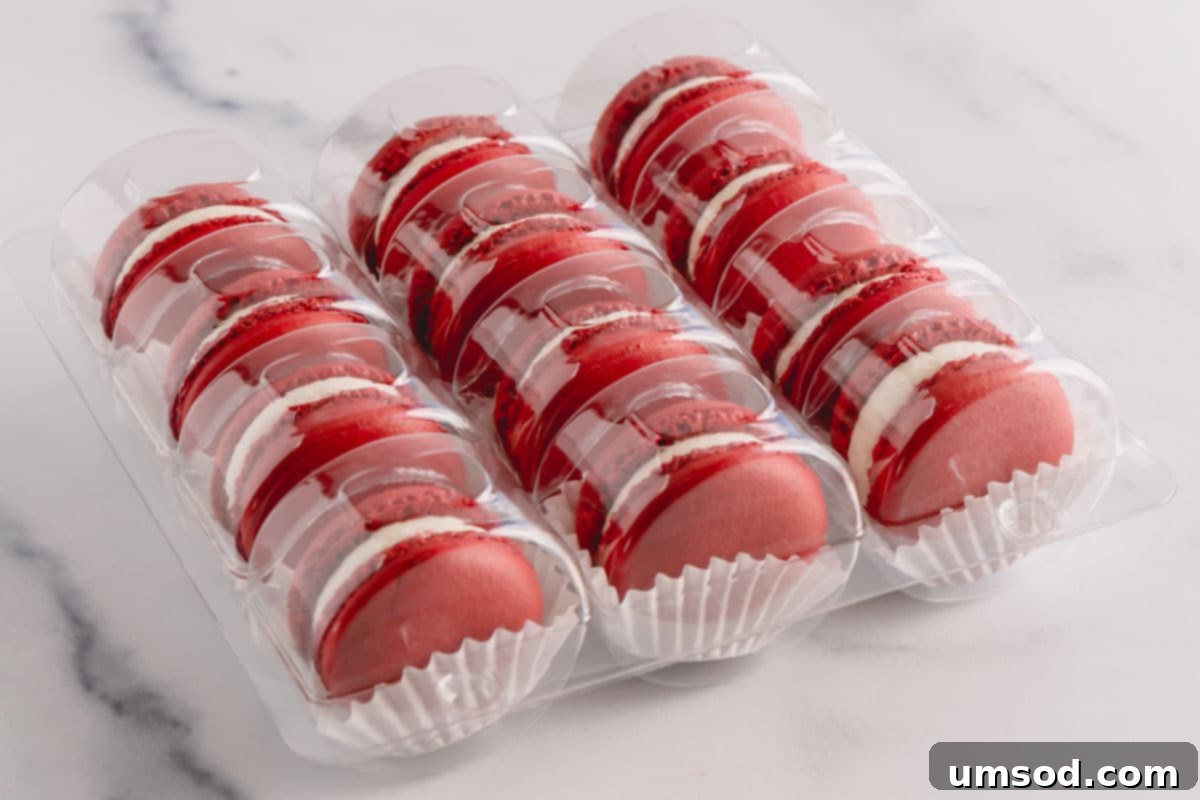
While clamshell plastic containers are convenient for displaying macarons, they are often not truly airtight. If you use such a container for refrigeration or freezing, it’s highly recommended to place the entire clamshell container inside a freezer bag. This extra layer of protection will prevent moisture from reaching your macarons, keeping them fresh and preventing them from becoming soggy.
Macaron 101: A Comprehensive Guide
Ready to dive deeper? Master the art of French macarons and confidently create your own signature flavors with my comprehensive guide!
Red Velvet Macarons
Comment
Print Recipe
Ingredients
For macaron shells:
- 100 g super fine almond flour Note 1
- 65 g powdered sugar Note 2
- 1 tablespoon unsweetened cocoa powder Note 3
- 70 g egg whites at room temperature Note 4
- ¼ teaspoon cream of tartar Note 5
- ¼ teaspoon salt
- 75 g fine granulated sugar Note 6
- 1 teaspoon red gel food coloring Note 7
- 1/2 teaspoon pure vanilla extract
For cream cheese filling:
- ¼ cup (55 g) cream cheese softened
- ¼ cup (56 g) unsalted butter softened
- 1 cup (120 g) powdered sugar
- ½ teaspoon pure vanilla extract
- 1/8 teaspoon coarse kosher salt
Instructions
To make macaron shells:
- Preheat the oven to 300°F (150°C). Line 2 baking sheets with parchment paper, Teflon sheet, or a silicone mat.
- To prepare dry ingredients: Sift together almond flour, powdered sugar, and cocoa powder twice. If you have up to 2 tablespoons of chunky dry ingredients left in the sifter, you don’t have to replace it. Simply discard those chunky bits.
- To make meringue: In a clean mixing bowl with a whisk attachment, combine egg whites, granulated sugar, cream of tartar, and salt. Beat the mixture on medium speed until soft peaks form. (I set it to speed 4 on my KitchenAid stand mixer. It takes 30-40 minutes to whip the meringue, but it’s well worth it for nice and full shells.)
- When the meringue reaches soft peaks stage, add red gel food coloring and vanilla extract.
- Continue beating the egg whites on the same medium-low speed until hard peaks form. Visual cues: Meringue should ball up inside the whisk, and when you lift the whisk, the meringue should hold a pointy end and have sharp ribs.
- To make batter: Sift the almond flour mixture into the meringue. Using a silicone spatula, fold the dry ingredients into the meringue until fully incorporated. Then continue to fold the batter until it’s runny enough to draw a figure eight. To test, take a small amount of batter and drop it into the bowl. If the small peaks dissolve into the batter on its own in about 10 seconds, the batter is ready. If not, fold a couple more times and test again. Be careful not to over-fold the batter. (TIP: Making French macarons is all about the technique. This is one of the most crucial steps. Let me try to describe the folding motion as best as I can: run the spatula clockwise from the bottom, up around the sides, and cut the batter in half. If you’re a beginner macaron-baker, I suggest counting every fold. It takes roughly about 50 folds to reach the proper consistency. After 50 folds, start testing the batter, and continue testing after every couple of folds.)
- To pipe macaron shells: Transfer the batter into a pastry bag, fitted with a round tip. (I used this Wilton 12 tip.)
- Hold the pastry bag at a straight 90° angle and pipe about 1.5-inch rounds about an inch apart on prepared baking sheets. (TIP 2: Download my free macaron template. Simply pipe the batter to fill the inner circle.)
- Tap the baking sheets firmly on the counter (or using your hand) a few times to get rid of any air bubbles. You can also use a toothpick to burst some large air bubbles. This step ensures smooth tops.
- Let the macarons rest on the counter for 15-30 minutes before baking, until a pellicle (skin) forms.
- To bake: Working one baking sheet at a time, place one tray with macarons on the middle rack. (TIP: To prevent browning, place an empty baking sheet on the top rack to shield the heat.) Bake for about 15-18 minutes. It’ll take longer for larger macarons. To test for doneness, touch a macaron lightly and try to move it. If it slides and wobbles, bake a minute or so longer. The cooked macarons should be firm to touch and the base shouldn’t move. (TIP: It’s always better to slightly over-bake macarons than under-bake them!)
- Cool macarons completely and then remove the shells from the parchment paper. (TIP: Don’t remove the shells while warm, you may risk breaking the shells, or the bottom might get stuck to the baking surface.)
To make the filling:
- While macarons bake, prepare the cream cheese filling. In a mixing bowl with a whisk attachment, beat the cream cheese and butter until fluffy. Add powdered sugar, vanilla extract, and salt and beat until well combined and smooth.
- Transfer the filling into a pastry bag fitted with a round piping tip. (I used Wilton 10 piping tip.)
To assemble:
- Pair the macaron shells by size and arrange them on a wire rack. Line them up so that bottom shells are upside down.
- Pipe a dollop of filling on the bottom shells. Place the top shell over the filling and press lightly so the filling spreads till the edges.
- Store the filled macarons in an airtight container in the fridge for at least 8 hours to mature, which allows the filling to soften and flavor the shells.
- To serve, bring the macarons out about 30 minutes prior to serving.
⭐️ Did you make this recipe?
Please leave a review and let us know how you liked it!
Video
Tips & Notes
Note 2: I don’t recommend making your own powdered sugar, because commercial powdered sugar has cornstarch in it, which helps with the texture of the cookies.
Note 3: For this recipe, you can use either natural or Dutch-processed cocoa powder.
Note 4: I’ve had success with carton egg whites (Bob Evans brand). You’ll need 1/3 cup of egg whites.
Note 5: Cream of tartar is optional and can be omitted. However, it helps to stabilize egg whites and create sturdier meringue. It’s just an extra insurance!
Note 6: It’s important to use fine granulated sugar for meringue, as it dissolves quicker. You can also use caster sugar, aka baker’s sugar.
Note 7: I used this gel food coloring.
GOT MACARON TROUBLE? Check out my macaron troubleshooting guide for common issues and solutions.
Nutrition
This recipe was originally published on June 27, 2016.